-
Neo-Colonial Influences and Corporate Governance Emergence A Case for Corporate Governance Divergence
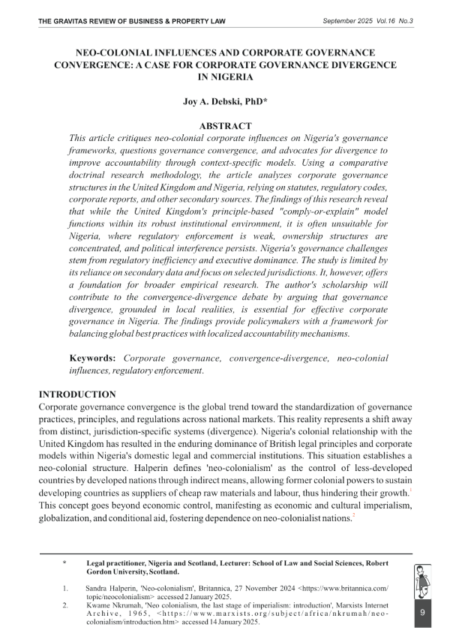
0₦2,500.00Joy Debski, in her article, Neo-Colonial Influences and Corporate Governance Emergence: A Case for Corporate Governance Divergence, critiques neo-colonial corporate influences on Nigeria’s governance frameworks, questions governance convergence, and advocates for divergence to improve accountability through context-specific models. Using a comparative doctrinal research methodology, Debski analyzes corporate governance structures in the United Kingdom and Nigeria, relying on statutes, regulatory codes, corporate reports, and other secondary sources. The findings of this research reveal that while the United Kingdom’s principle-based “comply-or explain” model functions within its robust institutional environment, it is often unsuitable for Nigeria, where regulatory enforcement is weak, ownership structures are concentrated, and political interference persists. Nigeria’s governance challenges stem from regulatory inefficiency and executive dominance. The study is limited by its reliance on secondary data and focus on selected jurisdictions. Debski, however, offers a foundation for broader empirical research. Debski argues that governance divergence, grounded in local realities, is essential for effective corporate governance in Nigeria. The findings provide policymakers with a framework for balancing global best practices with localized accountability mechanisms.
-
The Premises for Regulating Social Media in Nigeria: A Critical Examination
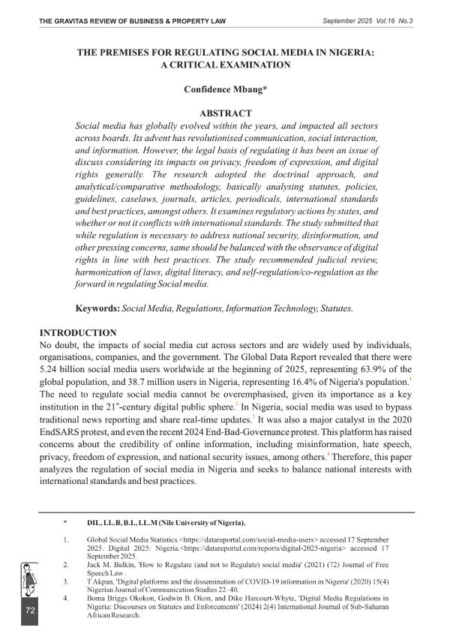
0₦2,500.00Social media has globally evolved over the years and impacted all sectors across boards. Its advent has revolutionised communication, social interaction, and information. However, the legal basis of regulating it has been an issue of discussion, considering its impacts on privacy, freedom of expression, and digital rights generally. Confidence Mbang, in his article, The Premises for Regulating Social Media in Nigeria: A Critical Examination, adopts the doctrinal approach and analytical/comparative methodology, basically analysing statutes, policies, guidelines, case laws, journals, articles, periodicals, international standards, and best practices, amongst others. Mbang examines regulatory actions by states and whether or not it conflicts with international standards. Mbang submits that while regulation is necessary to address national security, disinformation, and other pressing concerns, the same should be balanced with the observance of digital rights in line with best practices. Mbang recommends judicial review, harmonization of laws, digital literacy, and self-regulation/co-regulation as the way forward in regulating Social media.
-
Innovatively Finding Financing For Nigeria’s Energy Projects and Hostilities
0₦2,500.00Samuel Dunmade, in his article, Innovatively Finding Financing For Nigeria’s Energy Projects and Hostilities, interrogates how energy projects in Nigeria can be financed within persistently hostile economic, regulatory, and socio-political conditions. Rather than rehearsing conventional project finance doctrine, it adopts a context-sensitive legal and financial analysis that evaluates both traditional and non-traditional financing instruments through their capacity to withstand structural risk. It proceeds from the premise that conventional financing models, when transposed uncritically, are ill-suited to environments characterised by regulatory uncertainty, macroeconomic volatility, and security risks, and advances the argument that bankability in Nigeria’s energy sector depends less on capital availability than on the legal engineering of financing structures that reallocate risk, protect cash flows, and align with global capital trends. By examining resource-backed financing, hybrid instruments, climate-aligned capital, and risk-transfer mechanisms, Dunmade contributes a pragmatic framework for structuring energy finance in high-risk jurisdictions.
-
The Role of Transaction Avoidance Mechanisms in Corporate Insolvency Law in Nigeria
0₦2,500.00Business failure is a recurring phenomenon that cannot be ignored. Several factors contribute to corporate insolvency, including inefficient corporate management, corruption, the socio-political and economic environment, and government policies. Meanwhile, the primary financial burden of corporate insolvency is shifted to the creditors. They are therefore the most vulnerable and most exposed when a corporation fails. The protection of creditors in such situations has remained a challenging legal issue to address in a just and efficient manner, and options adopted have, in most instances, failed to offer full protection. Considering the above legal problem, Ejims Enwukwe, in his article, The Role of Transaction Avoidance Mechanisms in Corporate Insolvency Law in Nigeria, explores and analyzes the legal dynamics and complexities of transaction avoidance mechanisms in the protection of creditors under Nigerian insolvency law. Enwukwe concludes that transaction avoidance, when properly applied, has strong potential to protect creditors in corporate insolvency. This is without prejudice to some of the identified limitations of the mechanism. Nevertheless, the existing framework is a commendable start that Nigeria can further build on to better protect creditors in corporate insolvency. Enwukwe recommends legislative intervention to strengthen and optimize the role of transaction avoidance in protecting creditors in corporate insolvency.
-
The Liability of Brand Influencing for Defective or Inappropriate Business Promotion and Marketing: A Review of the Applicable Laws in Nigeria
0₦2,500.00Patrick Akwu and Aghoghomena Arhere, in their article, The Liability of Brand Influencing for Defective or Inappropriate Business Promotion and Marketing: A Review of the Applicable Laws in Nigeria, interrogate how the rise of social media has fundamentally transformed marketing strategies, with businesses increasingly relying on celebrities and influencers to promote their products and services. While these endorsements significantly enhance consumer reach and acceptance, they raise critical questions about liability when the products or services are defective, misleading, or harmful. Akwu and Arhere analyze the evolving regulatory landscape in Nigeria and examine the liability of brand influencers for engaging in defective advertising practices or promoting defective products and services. Akwu and Arhere explore the dual relationship that brand influencers maintain: contractually with product manufacturers through endorsement agreements, and through common law duties of care with their audience and followers. In conclusion, Akwu and Arhere establish that influencers must exercise due diligence in business promotion, as Nigeria’s current legal regime provides avenues for consumer redress and sanctions for deceptive advertising practices.
-
A Cross-Jurisdictional Legal and Risk Analysis for Corporate Board Oversight of Artificial Intelligence
0₦2,500.00The growing use of artificial intelligence (AI) in business brings new risks that company boards must take seriously. Joy Debski and Joshua Olewu, in their article, A Cross-Jurisdictional Legal and Risk Analysis for Corporate Board Oversight of Artificial Intelligence, look at how boards are expected to manage these risks as part of their duty to oversee company operations. Using a doctrinal comparative approach, Debski and Olewu examine four jurisdictions: the European Union, the U.S.A, China, and Nigeria to show how different laws and systems shape board responsibilities. Drawing from comparative statutory frameworks from selected jurisdictions, Debski and Olewu highlight areas of liability, compliance obligations, and ethical risks. They also draw on the agency and stewardship theories of corporate governance to analyze real-world examples, including Uber’s algorithmic misclassification and Amazon’s AI hiring bias case, to explain the need for Board oversight of AI. Based on the findings, Debski and Olewu suggest best practices for boards, provide recommendations for regulators and researchers, and call for more real-world studies on how boards are handling AI today.
-
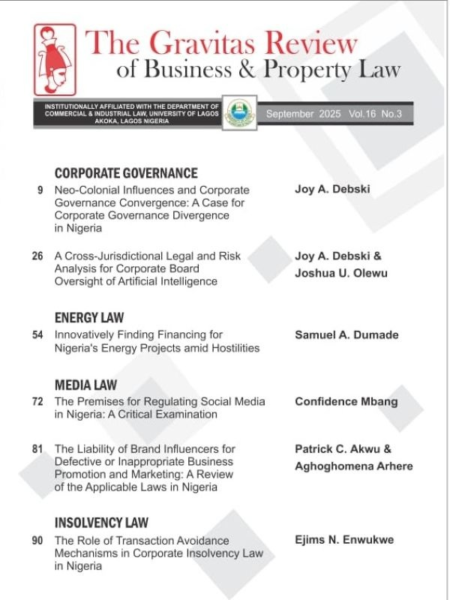
The Gravitas Review of Business & Property Law Vol.16 No.3
0₦5,000.00In this issue of The Gravitas Review of Business & Property Law Vol.16 No.3, there are well researched articles on:
- Corporate Governance
- Energy Law
- Media Law
- Insolvency Law
-
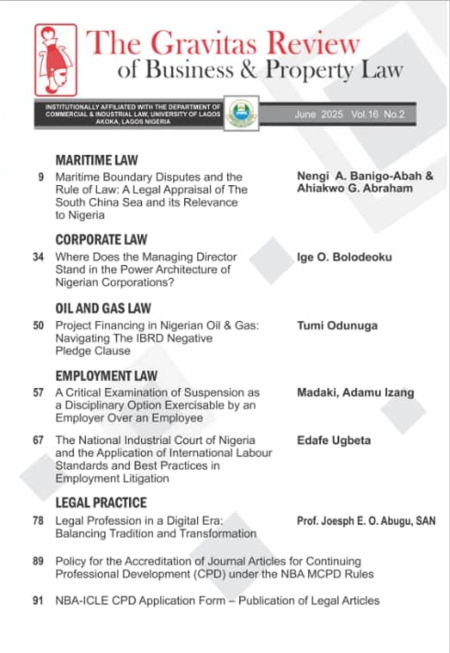
The Gravitas Review of Business & Property Law Vol.16 No.2 – Print
0₦5,000.00In this issue of The Gravitas Review of Business & Property Law Vol.16 No.2, there are well researched articles on:
- Maritime Law
- Corporate Law
- Energy Law
- Employment Law
- Legal Practice
-
The Gravitas Review of Business & Property Law Vol.16 No.2 – E-Book
0₦5,000.00In this issue of The Gravitas Review of Business & Property Law Vol.16 No.2, there are well researched articles on:
- Maritime Law
- Corporate Law
- Energy Law
- Employment Law
- Legal Practice
-
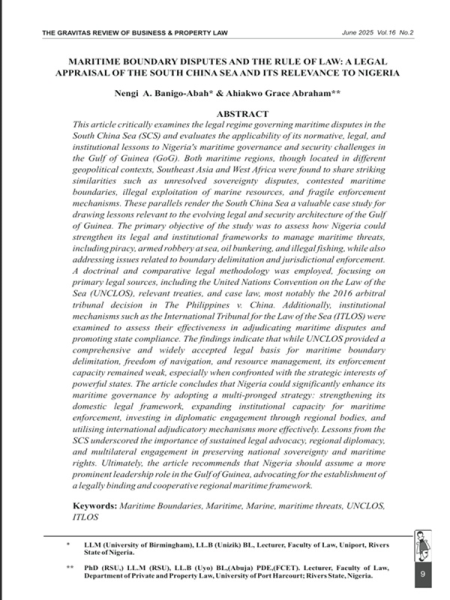
Maritime Boundary Disputes and the Rule of Law: A Legal Appraisal of the South China Sea and its Relevance to Nigeria
0₦2,500.00Nengi Banigo-Abah and Ahiakwo Abraham in their article, Maritime Boundary Disputes and the Rule of Law: A Legal Appraisal of the South China Sea and its Relevance to Nigeria, critically examine the legal regime governing maritime disputes in the South China Sea (SCS). Banigo-Abah and Abraham evaluate the applicability of its normative, legal, and institutional lessons to Nigeria’s maritime governance and security challenges in the Gulf of Guinea (GoG). Both maritime regions, though located in different geopolitical contexts, Southeast Asia and West Africa were found to share striking similarities such as unresolved sovereignty disputes, contested maritime boundaries, illegal exploitation of marine resources, and fragile enforcement mechanisms. These parallels render the South China Sea a valuable case study for drawing lessons relevant to the evolving legal and security architecture of the Gulf of Guinea. The primary objective of the study was to assess how Nigeria could strengthen its legal and institutional frameworks to manage maritime threats, including piracy, armed robbery at sea, oil bunkering, and illegal fishing, while also addressing issues related to boundary delimitation and jurisdictional enforcement. A doctrinal and comparative legal methodology was employed, focusing on primary legal sources, including the United Nations Convention on the Law of the Sea (UNCLOS), relevant treaties, and case law. The findings indicate that while UNCLOS provided a comprehensive and widely accepted legal basis for maritime boundary delimitation, freedom of navigation, and resource management, its enforcement capacity remained weak, especially when confronted with the strategic interests of powerful states. Banigo-Abah and Abraham conclude that Nigeria could significantly enhance its maritime governance by adopting a multi-pronged strategy: strengthening its domestic legal framework, expanding institutional capacity for maritime enforcement, investing in diplomatic engagement through regional bodies, and utilising international adjudicatory mechanisms more effectively.
-
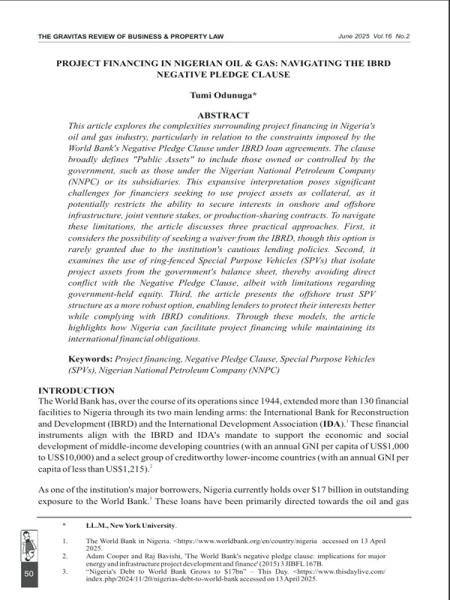
Project Financing in Nigerian Oil & Gas: Navigating the IBRD Clause
0₦2,500.00Tumi Odunuga in his article, Project Financing in Nigerian Oil & Gas: Navigating the IBRD Clause, explores the complexities surrounding project financing in Nigeria’s oil and gas industry, particularly in relation to the constraints imposed by the World Bank’s Negative Pledge Clause under IBRD loan agreements. The clause broadly defines “Public Assets” to include those owned or controlled by the government, such as those under the Nigerian National Petroleum Company (NNPC) or its subsidiaries. This expansive interpretation poses significant challenges for financiers seeking to use project assets as collateral, as it potentially restricts the ability to secure interests in onshore and offshore infrastructure, joint venture stakes, or production-sharing contracts. To navigate these limitations, Odunuga discusses three practical approaches. First, Odunuga considers the possibility of seeking a waiver from the IBRD, though this option is rarely granted due to the institution’s cautious lending policies. Second, Odunuga examines the use of ring-fenced Special Purpose Vehicles (SPVs) that isolate project assets from the government’s balance sheet, thereby avoiding direct conflict with the Negative Pledge Clause, albeit with limitations regarding government-held equity. Third, Odunuga presents the offshore trust SPV structure as a more robust option, enabling lenders to protect their interests better while complying with IBRD conditions. Through these models, Odunuga highlights how Nigeria can facilitate project financing while maintaining its international financial obligations.
-
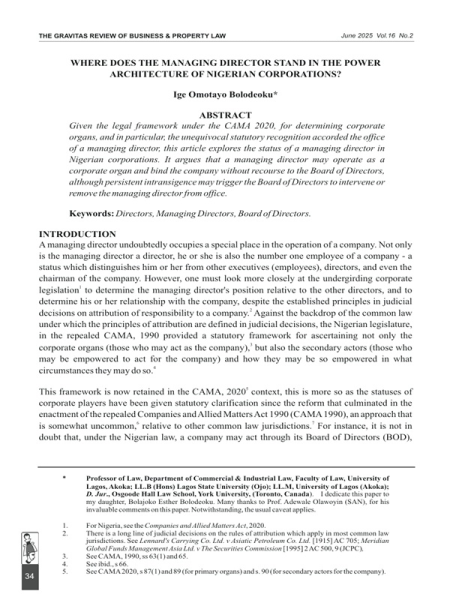
Where Does the Managing Director Stand in the Power Architecture of Nigerian Corporations?
0₦2,500.00Given the legal framework under the CAMA 2020, which determines corporate organs, and in particular, the unequivocal statutory recognition accorded to the office of a managing director, Professor Ige Bolodeoku, in his article Where Does the Managing Director Stand in the Power Architecture of Nigerian Corporations?, explores the status of a managing director in Nigerian corporations. Bolodeoku argues that a managing director may operate as a corporate organ and bind the company without recourse to the Board of Directors. However, persistent intransigence may trigger the Board of Directors to intervene or remove the managing director from office.
The Gravitas Review of Business & Property Law