-
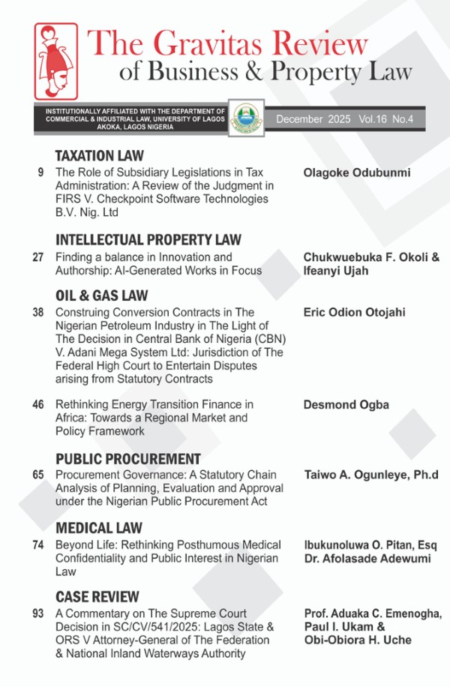
The Gravitas Review of Business & Property Law Vol.16 No.4 – Print
0₦5,000.00In this issue of The Gravitas Review of Business & Property Law Vol.16 No.4, there are well researched articles on:
- Taxation
- Intellectual Property
- Oli & Gas
- Public Procurement
- Medical Law
- Case Review
-
The Gravitas Review of Business & Property Law Vol.16 No.4 – E-Book
0₦5,000.00In this issue of The Gravitas Review of Business & Property Law Vol.16 No.4, there are well researched articles on:
- Taxation
- Intellectual Property
- Oli & Gas
- Public Procurement
- Medical Law
- Case Review
-
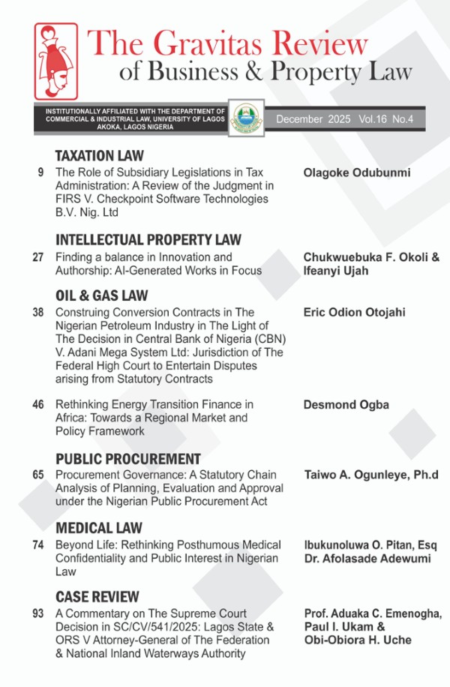
The Gravitas Review of Business & Property Law Vol.16 No.4
0₦5,000.00In this issue of The Gravitas Review of Business & Property Law Vol.16 No.4, there are well researched articles on:
- Taxation
- Intellectual Property
- Oli & Gas
- Public Procurement
- Medical Law
- Case Review
-
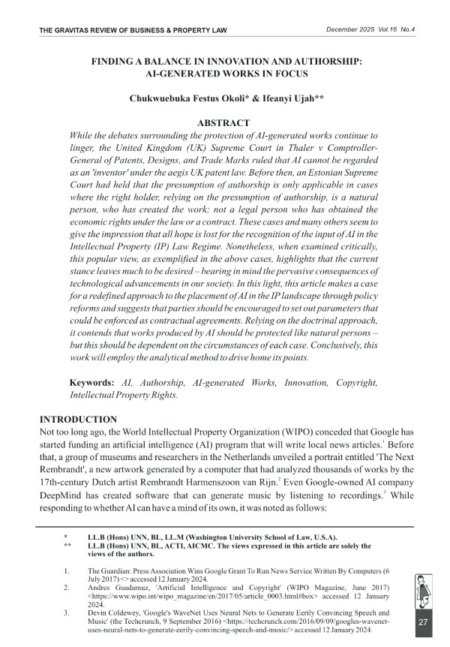
Finding a Balance in Innovation and Authorship: AI-Generated Works in Focus
0₦2,500.00Chukwuebuka Okoli and Ifeanyi Ujah, in their article, Finding a Balance in Innovation and Authorship: AI-Generated Works in Focus, venture into the legal basis of protecting AI generated works. While the debates surrounding the protection of AI-generated works continue to linger, the United Kingdom (UK) Supreme Court in Thaler v Comptroller-General of Patents, Designs, and Trade Marks ruled that AI cannot be regarded as an ‘inventor’ under the aegis of UK patent law. Before then, the Estonian Supreme Court had held that the presumption of authorship applies only in cases where the right holder, relying on the presumption, is a natural person who created the work, not a legal person who has obtained economic rights under the law or by contract. These cases and many others seem to give the impression that all hope is lost for the recognition of the input of AI in the Intellectual Property (IP) Law Regime. Nonetheless, when examined critically, this popular view, as exemplified in the above cases, highlights that the current stance leaves much to be desired – bearing in mind the pervasive consequences of technological advancements in our society. In this light, Okoli and Ujah make a case for a redefined approach to the placement of AI in the IP landscape through policy reforms and suggest that parties should be encouraged to set out parameters that could be enforced as contractual agreements. Relying on the doctrinal approach, it contends that works produced by AI should be protected like natural persons – but this should be dependent on the circumstances of each case. Conclusively, this work will employ the analytical method to drive home its points.
-
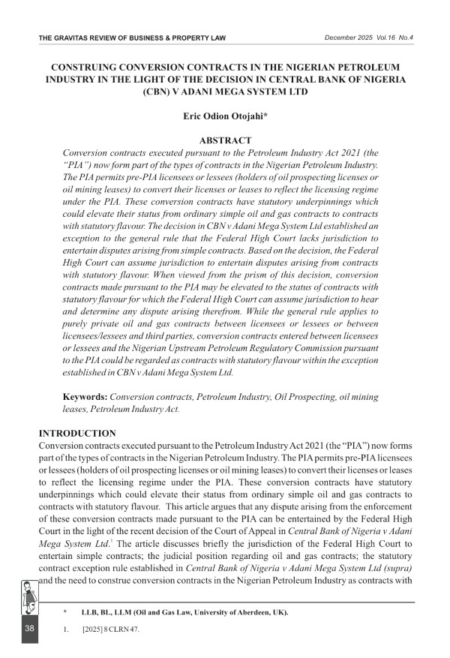
Construing Conversion Contracts in the Nigerian Petroleum Industry in the Light of the Decision in Central Bank of Nigeria (CBN) V. Adani Mega System Ltd: Jurisdiction of the Federal High Court to Entertain Disputes Arising From Statutory Contracts
0₦2,500.00Conversion contracts executed pursuant to the Petroleum Industry Act 2021 (the “PIA”) now form part of the types of contracts in the Nigerian Petroleum Industry. The PIA permits pre-PIA licensees or lessees (holders of oil prospecting licenses or oil mining leases) to convert their licenses or leases to reflect the licensing regime under the PIA. These conversion contracts have statutory underpinnings which could elevate their status from ordinary simple oil and gas contracts to contracts with statutory flavour. The decision in CBN v Adani Mega System Ltd established an exception to the general rule that the Federal High Court lacks jurisdiction to entertain disputes arising from simple contracts. Based on the decision, the Federal High Court can assume jurisdiction to entertain disputes arising from contracts with statutory flavour. When viewed from the prism of this decision, Eric Otojahi, in his article, Construing Conversion Contracts in the Nigerian Petroleum Industry in the Light of the Decision in Central Bank of Nigeria (CBN) V. Adani Mega System Ltd: Jurisdiction of the Federal High Court to Entertain Disputes Arising From Statutory Contracts, submits that conversion contracts made pursuant to the PIA may be elevated to the status of contracts with statutory flavour for which the Federal High Court can assume jurisdiction to hear and determine any dispute arising therefrom. While the general rule applies to purely private oil and gas contracts between licensees or lessees or between licensees/lessees and third parties, conversion contracts entered into between licensees or lessees and the Nigerian Upstream Petroleum Regulatory Commission pursuant to the PIA could be regarded as contracts with statutory flavour within the exception established in CBN v Adani Mega System Ltd.
-
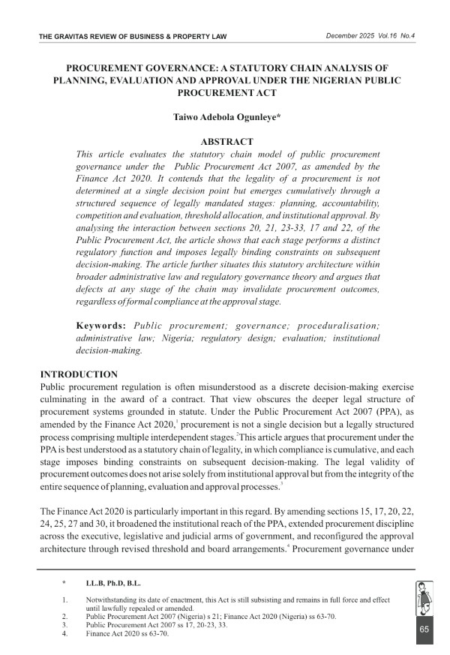
Procurement Governance: A Statutory Chain Analysis of Planning, Evaluation and Approval under the Nigerian Public Procurement Act
0₦2,500.00Taiwo Ogunleye, in his article, Procurement Governance: A Statutory Chain Analysis of Planning, Evaluation and Approval under the Nigerian Public Procurement Act, evaluates the statutory chain model of public procurement governance under the Public Procurement Act 2007, as amended by the Finance Act 2020. Ogunleye contends that the legality of a procurement is not determined at a single decision point but emerges cumulatively through a structured sequence of legally mandated stages: planning, accountability, competition and evaluation, threshold allocation, and institutional approval. By analysing the interaction between sections 20, 21, 23-33, 17 and 22 of the Public Procurement Act, Ogunleye shows that each stage performs a distinct regulatory function and imposes legally binding constraints on subsequent decision-making. Ogunleye further situates this statutory architecture within broader administrative law and regulatory governance theory and argues that defects at any stage of the chain may invalidate procurement outcomes, regardless of formal compliance at the approval stage.
-
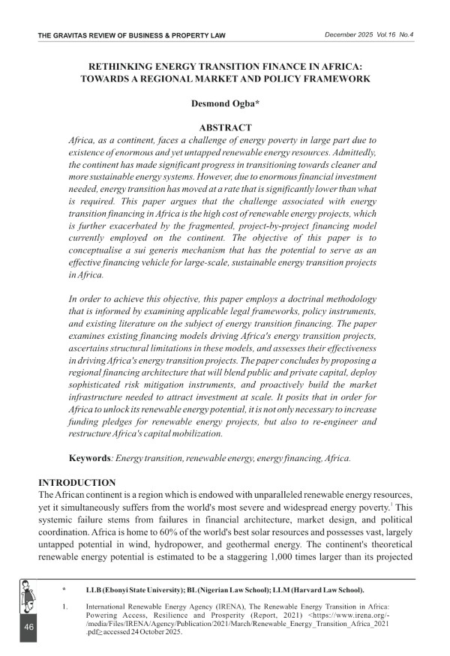
Rethinking Energy Transition Finance in Africa: Towards a Regional Market and Policy Framework
0₦2,500.00Africa, as a continent, faces a challenge of energy poverty in large part due to the existence of enormous and yet untapped renewable energy resources. Admittedly, the continent has made significant progress in transitioning towards cleaner and more sustainable energy systems. However, due to the enormous financial investment needed, energy transition has moved at a rate that is significantly lower than what is required. Desmond Ogba, in his article, Rethinking Energy Transition Finance in Africa: Towards a Regional Market and Policy Framework, argues that the challenge associated with energy transition financing in Africa is the high cost of renewable energy projects, which is further exacerbated by the fragmented, project-by-project financing model currently employed on the continent. Ogba conceptualises a sui generis mechanism that has the potential to serve as an effective financing vehicle for large-scale, sustainable energy transition projects in Africa. It employs a doctrinal methodology that is informed by examining applicable legal frameworks, policy instruments, and existing literature on the subject of energy transition financing. Ogba examines existing financing models driving Africa’s energy transition projects, ascertains structural limitations in these models, and assesses their effectiveness in driving Africa’s energy transition projects. Ogba concludes by proposing a regional financing architecture that will blend public and private capital, deploy sophisticated risk mitigation instruments, and proactively build the market infrastructure needed to attract investment at scale. It posits that for Africa to unlock its renewable energy potential, it is not only necessary to increase funding pledges for renewable energy projects but also to re-engineer and restructure Africa’s capital mobilization.
-
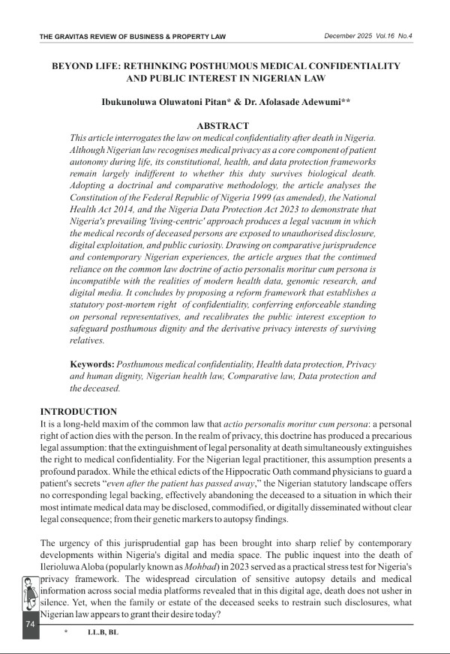
Beyond Life: Rethinking Posthumous Medical Confidentiality and Public Interest in Nigerian Law
0₦2,500.00Ibukunoluwa Pitan and Dr. Afolasade Adewumi, in their article, Beyond Life: Rethinking Posthumous Medical Confidentiality and Public Interest in Nigerian Law, interrogates the law on medical confidentiality after death in Nigeria. Although Nigerian law recognises medical privacy as a core component of patient autonomy during life, its constitutional, health, and data protection frameworks remain largely indifferent to whether this duty survives biological death. Adopting a doctrinal and comparative methodology, Pitan and Adewumi analyses the Constitution of the Federal Republic of Nigeria 1999 (as amended), the National Health Act 2014, and the Nigeria Data Protection Act 2023 to demonstrate that Nigeria’s prevailing ‘living-centric’ approach produces a legal vacuum in which the medical records of deceased persons are exposed to unauthorised disclosure, digital exploitation, and public curiosity. Drawing on comparative jurisprudence and contemporary Nigerian experiences, Pitan and Adewumi argues that the continued reliance on the common law doctrine of actio personalis moritur cum persona is incompatible with the realities of modern health data, genomic research, and digital media. Pitan and Adewumi concludes by proposing a reform framework that establishes a statutory post-mortem right of confidentiality, conferring enforceable standing on personal representatives, and recalibrates the public interest exception to safeguard posthumous dignity and the derivative privacy interests of surviving relatives.
-
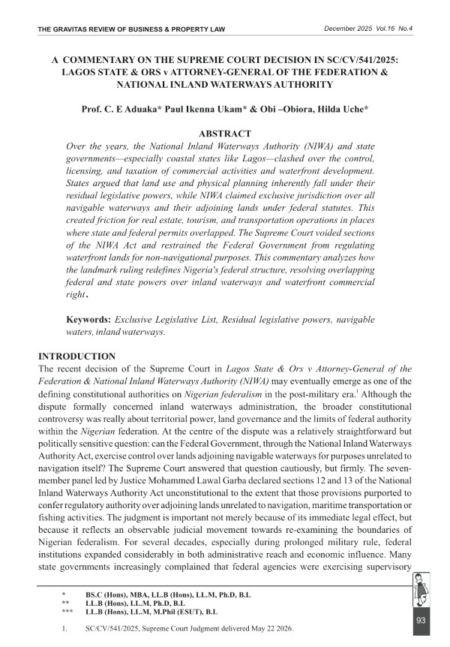
A Commentary on the Supreme court Decision in SC/CV/541/2025: Lagos State & Ors V. Attorney General of the Federation & National Inland Waterways Authority
0₦2,500.00Over the years, the National Inland Waterways Authority (NIWA) and state governments—especially coastal states like Lagos—clashed over the control, licensing, and taxation of commercial activities and waterfront development. States argued that land use and physical planning inherently fall under their residual legislative powers, while NIWA claimed exclusive jurisdiction over all navigable waterways and their adjoining lands under federal statutes. This created friction for real estate, tourism, and transportation operations in places where state and federal permits overlapped. The Supreme Court voided sections of the NIWA Act and restrained the Federal Government from regulating waterfront lands for non-navigational purposes. Prof. Charles Aduaka, Paul Ukam, and Uche Hilda Obi Obiora, in their article, A Commentary on the Supreme court Decision in SC/CV/541/2025: Lagos State & Ors V. Attorney General of the Federation & National Inland Waterways Authority, analyze how the landmark ruling redefines Nigeria’s federal structure, resolving overlapping federal and state powers over inland waterways and waterfront commercial right.
-
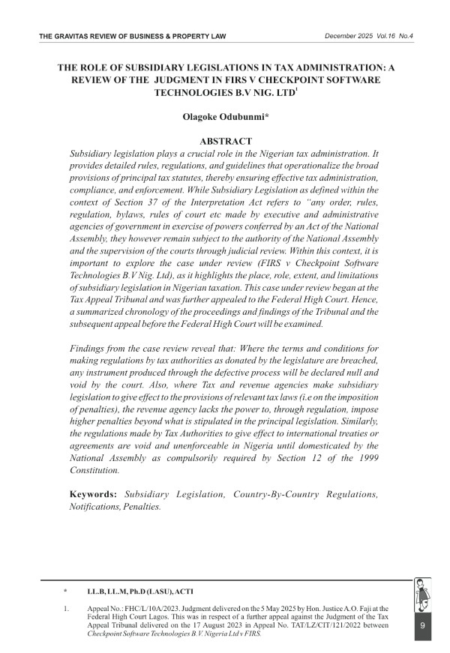
The Role of Subsidiary Legislation in Tax Administration: A Review of the Judgment in FIRS V. Checkpoint Software Technologies B.V. Nig. Ltd
0₦2,500.00Olagoke Odubunmi, in his article, The Role of Subsidiary Legislation in Tax Administration: A Review of the Judgment in FIRS V. Checkpoint Software Technologies B.V. Nig. Ltd., examines the role of subsidiary legislation in the Nigerian tax administration. Odubunmi provides detailed rules, regulations, and guidelines that operationalize the broad provisions of principal tax statutes, thereby ensuring effective tax administration, compliance, and enforcement. While Subsidiary Legislation, as defined within the context of Section 37 of the Interpretation Act, refers to “any order, rules, regulations, bylaws, rules of court etc., made by executive and administrative agencies of government in exercise of powers conferred by an Act of the National Assembly, they however remain subject to the authority of the National Assembly and the supervision of the courts through judicial review. Within this context, the author reviews the case of (FIRS v Checkpoint Software Technologies B.V Nig. Ltd), as it highlights the place, role, extent, and limitations of subsidiary legislation in Nigerian taxation. Findings from the case review reveal that: Where the terms and conditions for making regulations by tax authorities as donated by the legislature are breached, any instrument produced through the defective process will be declared null and void by the court. Also, where Tax and revenue agencies make subsidiary legislation to give effect to the provisions of relevant tax laws (e.g., on the imposition of penalties), the revenue agency lacks the power, through regulation, to impose higher penalties beyond what is stipulated in the principal legislation. Similarly, the regulations made by Tax Authorities to give effect to international treaties or agreements are void and unenforceable in Nigeria until domesticated by the National Assembly as compulsorily required by Section 12 of the 1999 Constitution.
-
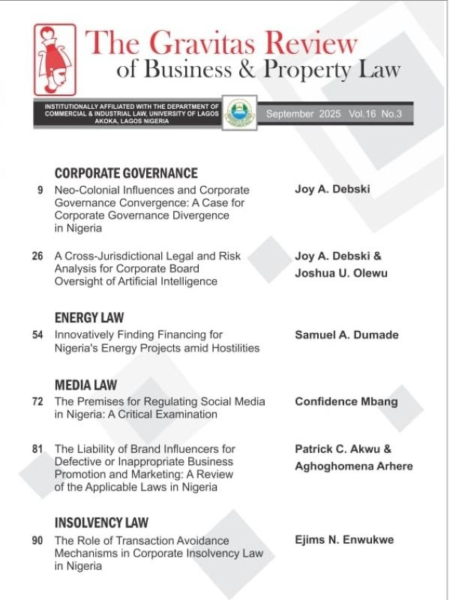
The Gravitas Review of Business & Property Law Vol.16 No.3 – Print
0₦5,000.00In this issue of The Gravitas Review of Business & Property Law Vol.16 No.3, there are well researched articles on:
- Corporate Governance
- Energy Law
- Media Law
- Insolvency Law
-
The Gravitas Review of Business & Property Law Vol.16 No.3 – E-Book
0₦5,000.00In this issue of The Gravitas Review of Business & Property Law Vol.16 No.3, there are well researched articles on:
- Corporate Governance
- Energy Law
- Media Law
- Insolvency Law
The Gravitas Review of Business & Property Law