-
The Gravitas Review of Business & Property Law Vol.11 No.4 – Print
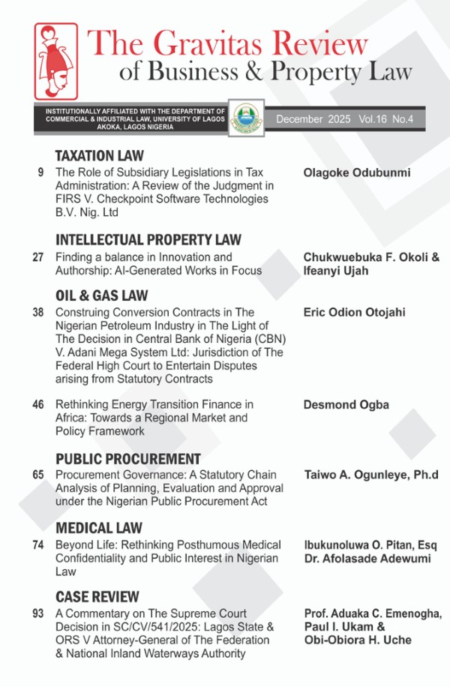
0₦5,000.00In this issue of The Gravitas Review of Business & Property Law Vol.11 No.4, there are well researched articles on:
- Commercial Law & Practice
- Corporate Law & Practice
- Banking Law & Practice
- Taxation
- Litigation Practice & Procedure
- Labour Law
- Energy Law
-
The Gravitas Review of Business & Property Law Vol.11 No.4 – E-Book
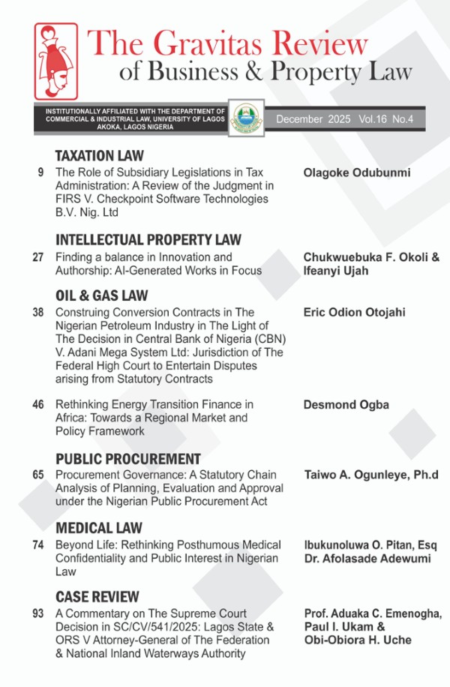
0₦5,000.00In this issue of The Gravitas Review of Business & Property Law Vol.11 No.4, there are well researched articles on:
- Commercial Law & Practice
- Corporate Law & Practice
- Banking Law & Practice
- Taxation
- Litigation Practice & Procedure
- Labour Law
- Energy Law
-
The Gravitas Review of Business & Property Law Vol.11 No.4
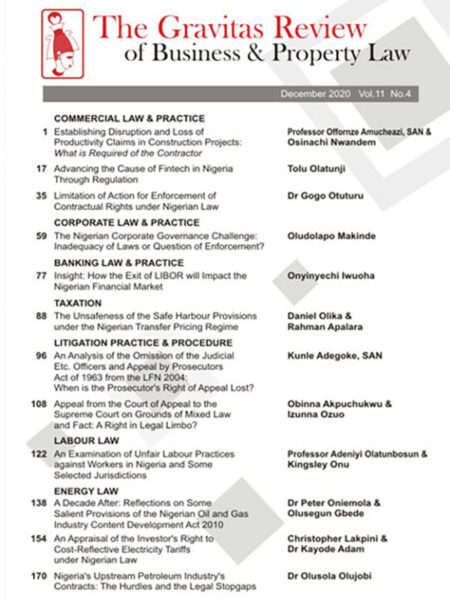
0₦5,000.00In this issue of The Gravitas Review of Business & Property Law Vol.11 No.4, there are well researched articles on:
- Commercial Law & Practice
- Corporate Law & Practice
- Banking Law & Practice
- Taxation
- Litigation Practice & Procedure
- Labour Law
- Energy Law
-
Nigeria’s Upstream Petroleum Industry’s Contracts: The Hurdles and the Legal Stopgaps
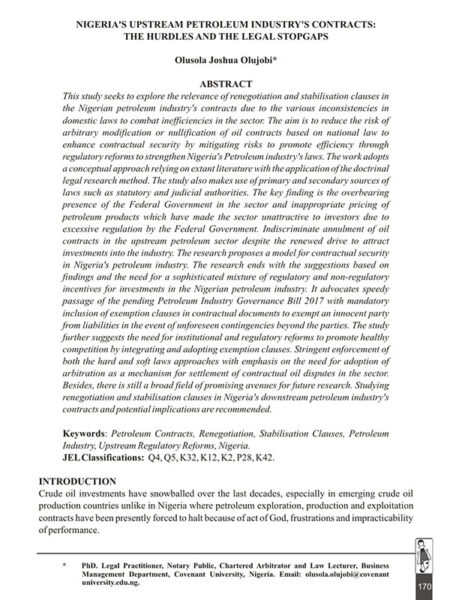
0₦2,500.00Dr Olusola Olujobi of the Business Management Department Covenant University Ota Nigeria in his article, Nigeria’s Upstream Petroleum Industry’s Contracts: The Hurdles and the Legal Stopgaps, explores the relevance of renegotiation and stabilisation clauses in the Nigerian petroleum industry’s contracts due to the various inconsistencies in domestic laws to combat inefficiencies in the sector. The overbearing presence of the Federal Government in the oil and gas sector and inappropriate pricing of petroleum products have made the sector unattractive to investors due to excessive regulation. Indiscriminate annulment of oil contracts is contrary to the government’s drive to attract investments and the need for contractual security in Nigeria’s petroleum industry. Dr Olujobi advocates the need for speedy passage of the Petroleum Industry Governance Bill 2017 and for institutional and regulatory reforms to promote healthy competition.
-
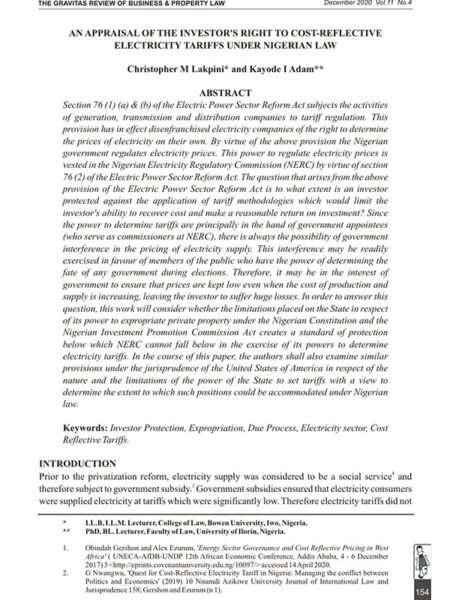
An Appraisal of the Investor’s Right to Cost-Reflective Electricity Tariffs Under Nigerian Law
0₦2,500.00Christopher Lakpini of the College of Law Bowen University Iwo Nigeria and Dr Kayode Adam of the Faculty of Law University of Ilorin Nigeria in their article, An Appraisal of the Investor’s Right to Cost-Reflective Electricity Tariffs Under Nigerian Law, observe that section 76 (1) (a) & (b) of the Electric Power Sector Reform Act (the Act) subjects the activities of generation, transmission and distribution companies to tariff regulation. This provision has robbed electricity companies of the right to determine the price of electricity automatically. Lakpini and Adam examine if power sector investors have a right to recover their cost and make a reasonable return on investment. They consider whether the limitation imposed by the Act amounts to expropriation under Nigerian law, and the treatment of similar provisions under the United States jurisprudence.
-
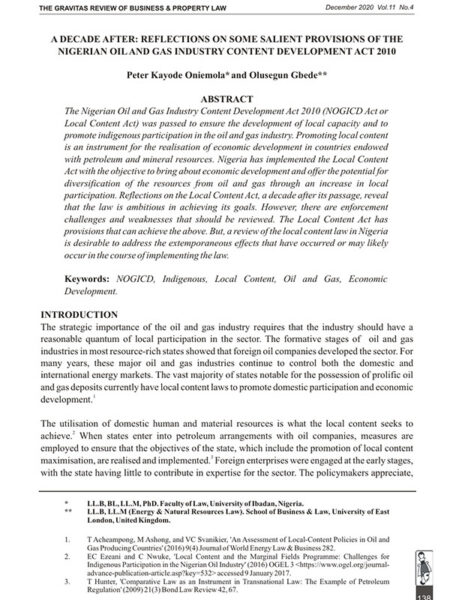
A Decade After: Reflections on Some Salient Provisions of the Nigerian Oil and Gas Industry Content Development Act 2010
0₦2,500.00Dr Peter Oniemola of the Faculty of Law University of Ibadan Nigeria and Olusegun Gbede of the School of Business & Law University of East London the United Kingdom in their article, A Decade After: Reflections on Some Salient Provisions of the Nigerian Oil and Gas Industry Content Development Act 2010, review the provisions of the Nigerian Oil and Gas Industry Content Development Act against the essence and expectation of the Act. They consider the achievements of the Act and challenges in realising its objectives.
-
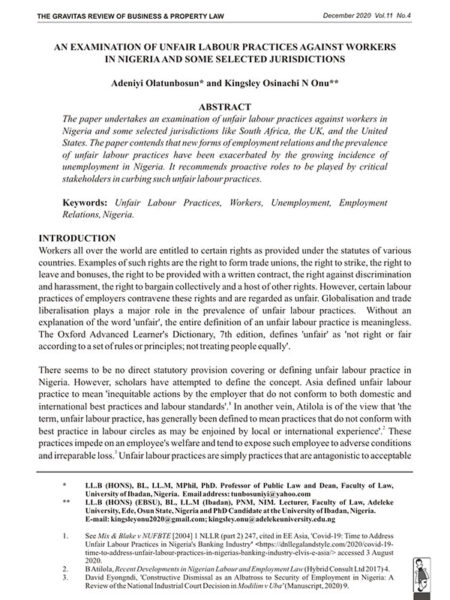
An Examination of Unfair Labour Practices Against Workers in Nigeria and Some Selected Jurisdictions
0₦2,500.00Professor Adeniyi Olatunbosun, Dean Faculty of Law, University of Ibadan Nigeria and Kingsley Onu of the Adeleke University Ede Nigeria in their article, An Examination of Unfair Labour Practices Against Workers in Nigeria and Some Selected Jurisdictions, undertake an examination of unfair labour practices in Nigeria, South Africa, the United Kingdom, and the United States of America. They contend that new forms of employment relations and the prevalence of unfair labour practices have been exacerbated by the growing incidence of unemployment in Nigeria.
-
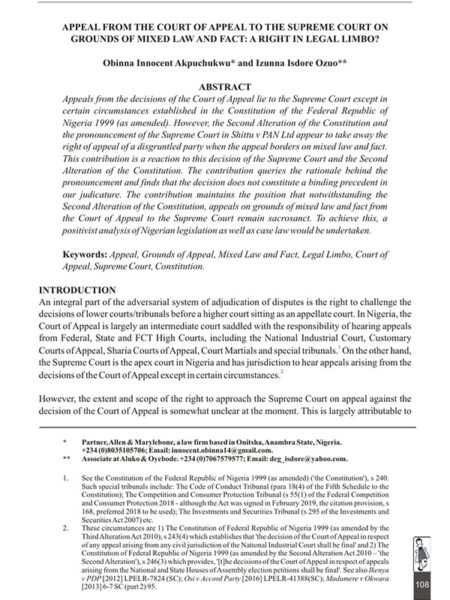
Appeal from the Court of Appeal to the Supreme Court on Grounds of Mixed Law and Fact: A Right in Legal Limbo?
0₦2,500.00Obinna Akpuchukwu, Partner Allen & Marylebone and Izunna Ozuo, Associate at Aluko & Oyebode in their article, Appeal from the Court of Appeal to the Supreme Court on Grounds of Mixed Law and Fact: A Right in Legal Limbo? note that Appeals from the decisions of the Court of Appeal lie to the Supreme Court except in certain circumstances established in the Constitution. However, a pronouncement of His Lordship Bode Rhodes-Vivour, JSC in Shittu v PAN Ltd and the Second Alteration of the Constitution appear to take away the right of appeal of an aggrieved party when the appeal borders on mixed law and fact. Obinna and Izunna query the rationale behind the pronouncement and argue that the decision does not constitute a binding precedent in Nigerian judicature. They opine that notwithstanding the Second Alteration of the Constitution, appeals on grounds of mixed law and fact from the Court of Appeal to the Supreme Court remain sacrosanct.
-
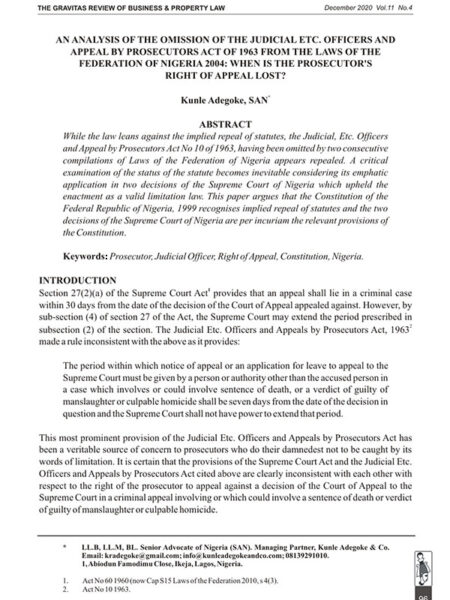
An Analysis of the Omission of the Judicial Etc. Officers and Appeal by Prosecutors Act of 1963 from the LFN 2004: When is the Prosecutor’s Right of Appeal Lost?
0₦2,500.00Kunle Adegoke, Managing Partner Kunle Adegoke & Co. in his article, An Analysis of the Omission of the Judicial Etc. Officers and Appeal by Prosecutors Act of 1963 from the LFN 2004: When is the Prosecutor’s Right of Appeal Lost?, argues that while the law leans against the implied repeal of statutes, the Judicial, Etc. Officers and Appeal by Prosecutors Act No 10 of 1963, having been omitted by two consecutive compilations of Laws of the Federation of Nigeria appears repealed. Adegoke examines the status of the statute against the background of the emphatic application of the statute in two decisions of the Supreme Court, which decisions upheld the enactment as a valid limitation law. Adegoke argues that the Constitution of the Federal Republic of Nigeria 1999 recognises implied repeal of statutes and the two decisions of the Supreme Court are per incuriam the relevant provisions of the Constitution.
-
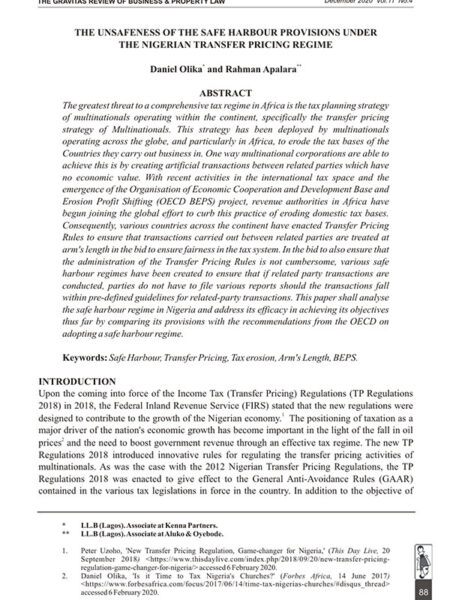
The Unsafeness of the Safe Harbour Provisions Under the Nigerian Transfer Pricing Regime
0₦2,500.00Daniel Olika of Kenna Partners and Rahman Apalara of Aluko & Oyebode in their article, The Unsafeness of the Safe Harbour Provisions Under the Nigerian Transfer Pricing Regime, note that a significant threat to a comprehensive tax regime in Africa is the tax planning, especially transfer pricing, strategy of multinationals. Multinationals have deployed the strategy to erode the tax bases of the countries where they carry out business. One way multinationals do this is by creating artificial transactions between related parties which have no economic value. With the emergence of the Organisation of Economic Cooperation and Development’s Base and Erosion Profit Shifting (OECD BEPS) project, tax authorities across the continent have enacted Transfer Pricing Rules to ensure that transactions carried out between related parties are treated at arm’s length. To ensure that the administration of the Transfer Pricing Rules is not cumbersome, various safe harbour regimes have been created to ensure that if related party transactions are conducted, parties do not have to file various reports should the transactions fall within pre-defined guidelines for related-party transactions. Daniel and Rahman analyse the safe harbour regime in Nigeria by comparing its provisions with the recommendations from the OECD on adopting a safe harbour regime.
-
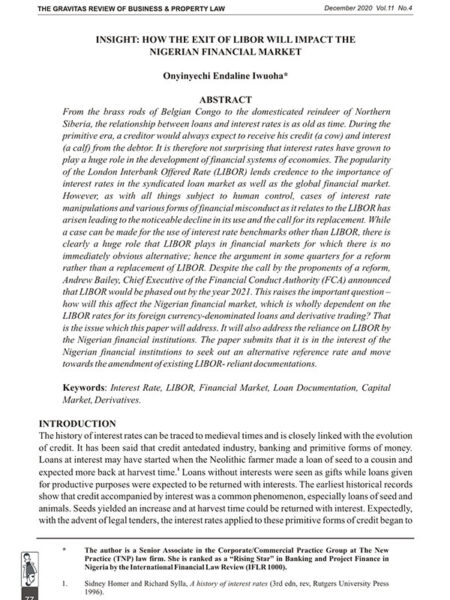
Insight: How the Exit of LIBOR Will Impact the Nigerian Financial Market
0₦2,500.00Onyinyechi Iwuoha, Senior Associate at the TNP Law Firm in her article, Insight: How the Exit of LIBOR Will Impact the Nigerian Financial Market, notes the popularity of the London Interbank Offered Rate (LIBOR) in financial markets worldwide. With the impending phasing out of LIBOR in 2021 by the (UK) Financial Conduct Authority due to what became known as the ‘LIBOR Scandal’, Onyinyenchi addresses how the exit of LIBOR would affect the Nigerian financial market which is wholly dependent on the LIBOR rates for its foreign currency-denominated loans and derivative trading; what alternative reference rates there are, and the amendment of existing LIBOR-reliant documentations.
-
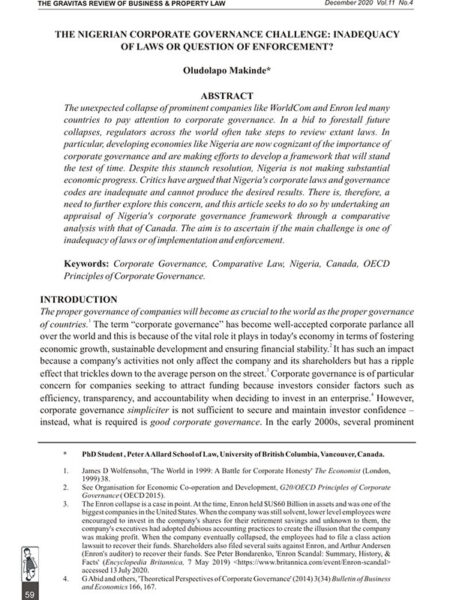
The Nigerian Corporate Governance Challenge: Inadequacy of Laws or Question of Enforcement
0₦2,500.00Oludolapo Makinde, PhD Student at the Peter Allard School of Law, University of British Columbia Vancouver Canada in her article, The Nigerian Corporate Governance Challenge: Inadequacy of Laws or Question of Enforcement, argues that while the need to develop a corporate governance framework that will stand the test of time is beyond question, it is debatable whether the corporate governance architecture in Nigeria is adequate. Makinde undertakes an appraisal of Nigeria’s corporate governance framework through a comparative analysis with that of Canada. The aim is to ascertain if the main challenge is one of the inadequacies of laws or implementation and enforcement.
The Gravitas Review of Business & Property Law