-

The Supreme Court of Nigeria Decision in Gbetu V. Itie: Is It a Case of Termination or Dismissal from Employment?
0₦2,500.00Faith Opara and Olasupo Bada in their case review article, The Supreme Court of Nigeria Decision in Gbetu V. Itie: Is It a Case of Termination or Dismissal from Employment? examine the decision of the Supreme Court in Gbedu v. Itie that employees’ whose employment was brought to an end by liquidation were by this token, dismissed from the employ of the liquidated company. Relying on primary and secondary data, they examine the propriety of this decision in the light of the legal connotation of termination and dismissal from employment. Opara and Bada examine the meaning and legal effect of termination and dismissal from employment under Nigerian labour jurisprudence and found that the decision was reached per incuriam. Therefore, lower courts are urged to distinguish and depart from the decision when faced with similar situation while the SCN is urged to overrule itself where the opportunity present itself subsequently.
-
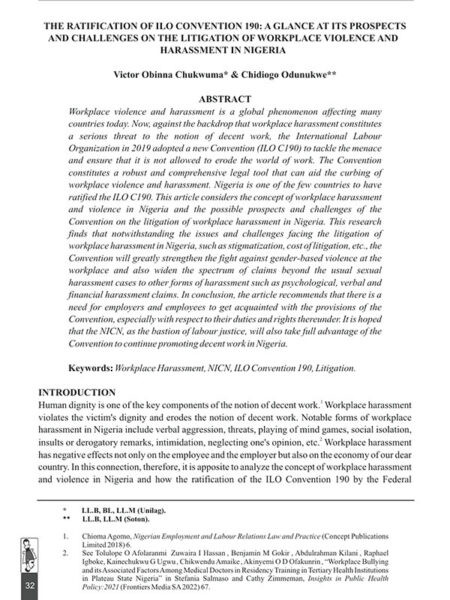
The Ratification of ILO Convention 190: A Glance at its Prospects and Challenges on the Litigation of Workplace Violence and Harassment in Nigeria
0₦2,500.00Victor Chukwuma and Chidiogo Odunukwe in their article, The Ratification of ILO Convention 190: A Glance at its Prospects and Challenges on the Litigation of Workplace Violence and Harassment in Nigeria, explore the ambit of workplace violence and harassment as a global phenomenon and the ILO’s adoption of a new Convention (ILO C190) in 2019 to specifically tackle the menace and to ensure that it is not allowed to erode the world of work. They consider the possible prospects and challenges of the Convention on the litigation of workplace harassment in Nigeria. They find that notwithstanding the issues and challenges facing the litigation of workplace harassment in Nigeria, the Convention will greatly strengthen the fight against gender-based violence at the workplace and also widen the spectrum of claims beyond the usual sexual harassment cases to other forms of harassment. They recommend that there is need for employers and employees to get acquainted with the provisions of the Convention especially with respect to their duties and rights thereunder.
-
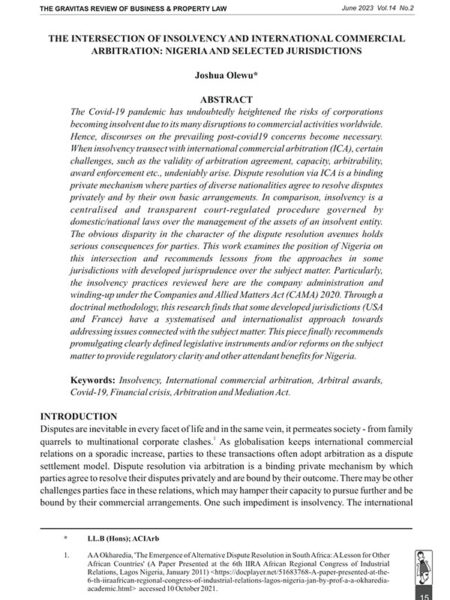
The Intersection of Insolvency and International Commercial Arbitration Nigeria and Selected Jurisdictions
0₦2,500.00Joshua Olewu in his article, The Intersection of Insolvency and International Commercial Arbitration: Nigeria and Selected Jurisdictions, examines the challenges posed by the intersection of insolvency with international commercial arbitration (ICA), such as validity of arbitration agreement, capacity, arbitrability, award enforcement etc,. He examines the position of Nigeria on this intersection and recommends lessons from the approaches in some jurisdictions with developed jurisprudence over the subject matter. Olewu, finds through a doctrinal methodology, that some developed jurisdictions (USA and France) have a systematized and internationalist approach towards addressing issues connected with the subject matter and recommends for Nigeria, the promulgation of clearly defined legislative instruments and/or reforms in order to provide regulatory clarity and other attendant benefits.
-
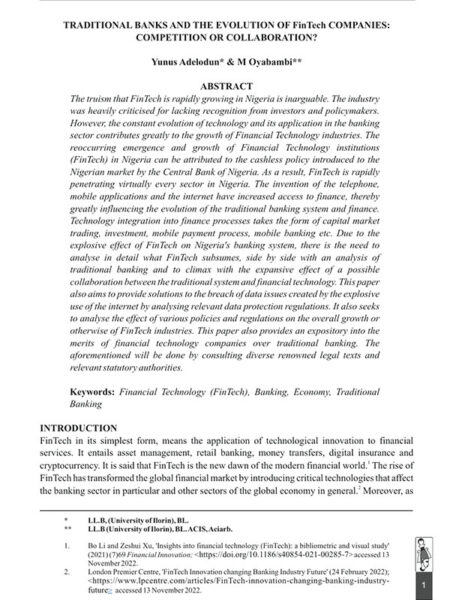
Traditional Banks and the Evolution of Fintech Companies: Competition or Collaboration?
0₦2,500.00Yunus Adelodun and M. Oyabambi in their article, Traditional Banks and the Evolution of Fintech Companies: Competition or Collaboration? examine the growing recognition of Fintechs, their technology and its application in the banking sector. They analyze in details what Fintech subsumes, side by side an analysis of traditional banking and climaxed with the expansive effect of a possible collaboration between the traditional system and financial technology. They provide solutions to the breach of data issues created by the explosive use of the internet, by providing an analysis of relevant data protection regulations. They also provide an expository into the merits of financial technology companies over traditional banking.
-
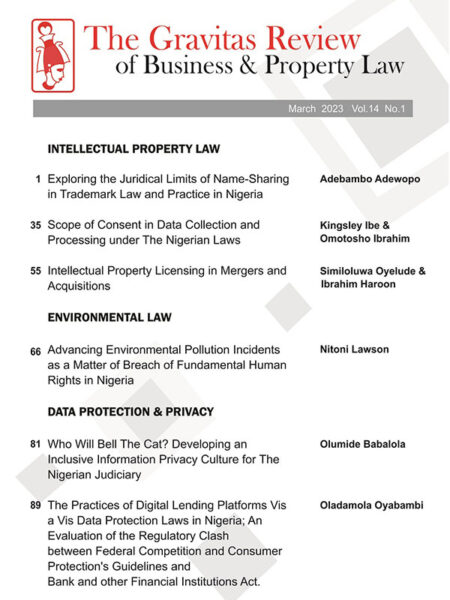
The Gravitas Review of Business & Property Law Vol.14 No.1 – Print
0₦5,000.00In this issue of The Gravitas Review of Business & Property Law Vol.14 No.1, there are well researched articles on:
- Intellectual Property Law
- Environmental Law
- Data Protection & Privacy
-
The Gravitas Review of Business & Property Law Vol.14 No.1 – E-Book
0₦5,000.00In this issue of The Gravitas Review of Business & Property Law Vol.14 No.1, there are well researched articles on:
- Intellectual Property Law
- Environmental Law
- Data Protection & Privacy
-
The Gravitas Review of Business & Property Law Vol.14 No.1
0₦5,000.00In this issue of The Gravitas Review of Business & Property Law Vol.14 No.1, there are well researched articles on:
- Intellectual Property Law
- Environmental Law
- Data Protection & Privacy
-
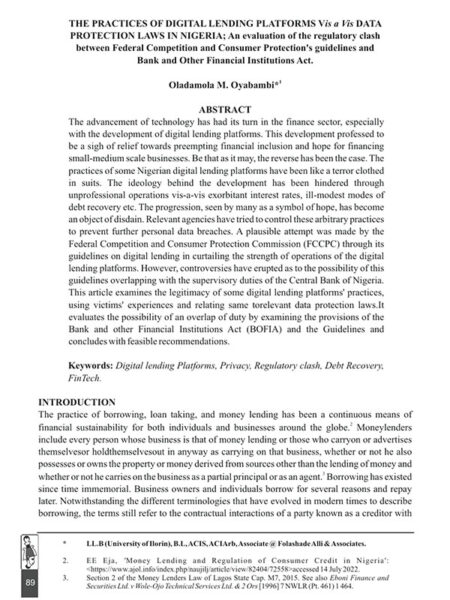
The Practices Of Digital Lending Platforms Vis A Vis Data Protection Laws In Nigeria
0₦2,500.00In his article, Practices Of Digital Lending Platforms Vis A Vis Data Protection Laws In Nigeria, Oladamola Oyabambi examines the legitimacy of the practices of some digital lending platforms, using experiences of victims and relating same with relevant data protection laws, Oyabambi evaluates the possibility of an overlap of duty by examining the provisions of the Bank and other Financial Institutions Act (BOFIA) and the Guidelines and concludes with feasible recommendations.
-
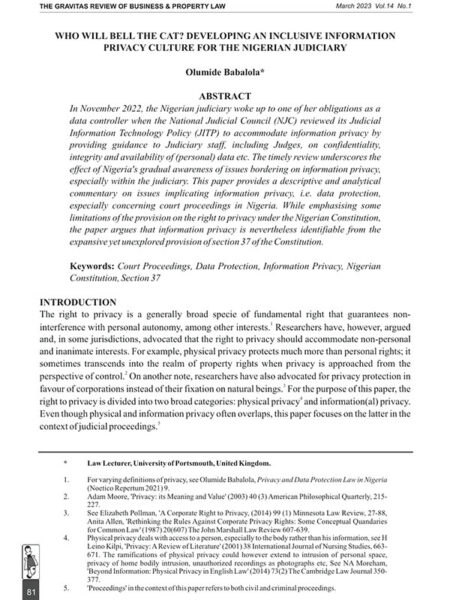
Who Will Bell the Cat? Developing an Inclusive Information Privacy Culture for the Judiciary
0₦2,500.00Olumide Babalola in his article, Who Will Bell the Cat? Developing an Inclusive Information Privacy culture for the Judiciary, provides a descriptive and analytical commentary on issues implicating information privacy i.e data protection, especially in relation to court proceedings in Nigeria. While emphasizing some limitations of the provision on the right to privacy under the Nigerian Constitution, Babalola argues that information privacy is nevertheless identifiable from the expansive yet unexplored provision of section 37 of the Constitution.
-
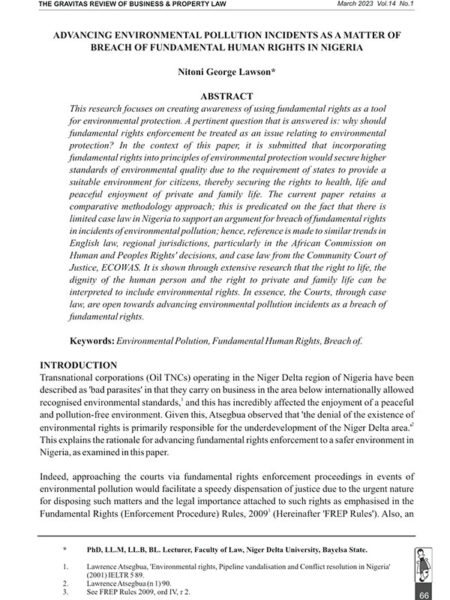
Advancing Environmental Pollution Incidents as a Matter of Breach of Fundamental Human rights in Nigeria
0₦2,500.00Nitoni George Lawson in his article, Advancing Environmental Pollution Incidents as a Matter of Breach of Fundamental Human Rights in Nigeria focuses on creating awareness on the use of fundamental rights as a tool for environmental protection. A pertinent question that is answered is: why should fundamental rights enforcement be treated as an issue relating to environmental protection? Lawson submittes that incorporating fundamental rights into principles of environmental protection would secure higher standards of environmental quality due to the requirement of states to provide a satisfactory environment for citizens, thereby, securing the rights to health, life and peaceful enjoyment of private and family life.
-
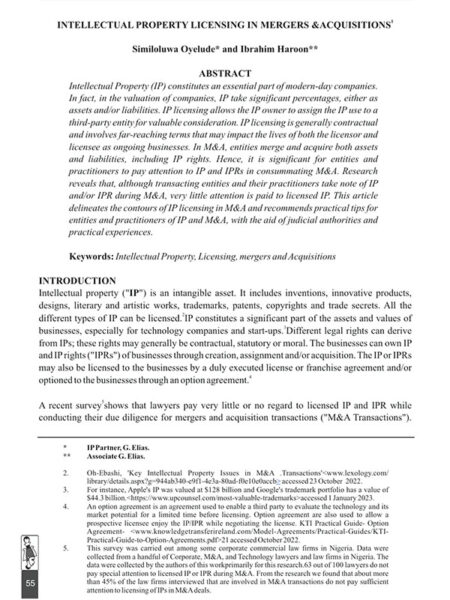
Intellectual Property Licensing in Mergers and Acquisitions
0₦2,500.00Similoluwa Oyelude and Haroon Ibrahim in his article, Intellectual Property Licensing in Mergers and Acquisitions, delineate the contours of IP licensing in M&A and recommends practical tips that are helpful for entities and practitioners of IP and M&A, with the aid of judicial authorities and practical experiences
-
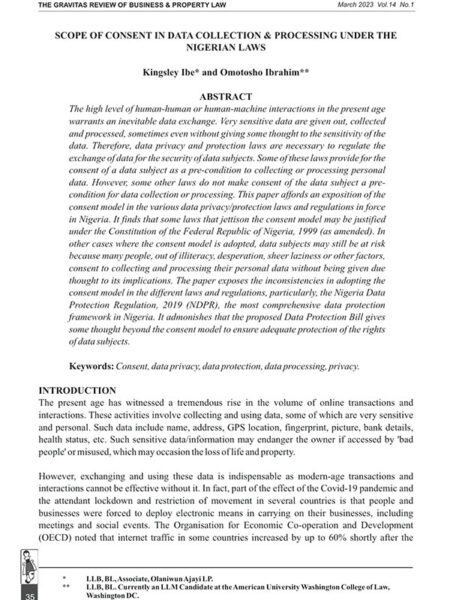
Scope of Consent in Data Collection and Processing under the Nigerian Laws
0₦2,500.00Kingsley Ibe and Omotosho Ibrahim, in their article Scope of Consent in Data Collection and Processing under the Nigerian Laws provide an exposition to the consent model in the various data privacy/protection laws and regulation in force in Nigeria. Some of the laws which jettison the consent model may be justified under the Constitution of the Federal Republic of Nigeria, 1999 (as amended). In other cases were the consent model is adopted, data subjects may still be at risk because many people, out of illiteracy, desperation, sheer laziness or other factors, consent to the collection and processing of their personal data without given due thought to its implications. Ibe and Ibrahim expose the inconsistencies in the adoption of the consent model in the different laws and regulations, particularly, the Nigeria Data Protection Regulation, 2019 (NDPR) which is the most comprehensive data protection framework in Nigeria. Ibe and Ibrahim admonish that the proposed Data Protection Bill give some thought beyond the consent model to ensure adequate protection of the rights of data subjects.
The Gravitas Review of Business & Property Law