-
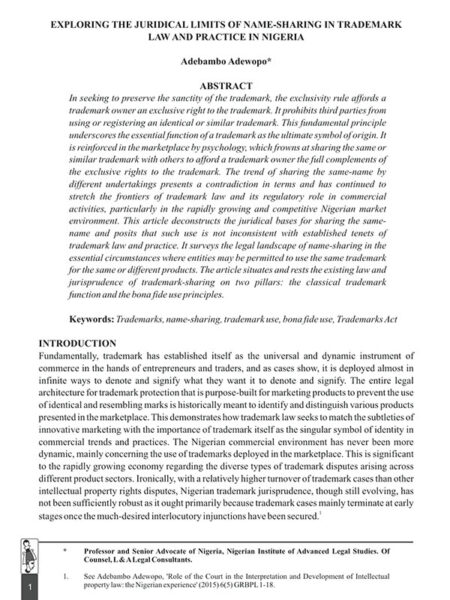
Exploring the Juridical Limits of Name Sharing in Trade Mark Law & Practice
0₦2,500.00Professor Adebambo Adewopo,in his article, Exploring the Juridical Limits of Name Sharing in Trade Mark Law & Practice explores the trend of sharing the same name by different undertakings in the rapidly growing and competitive Nigerian market environment. Prof Adewopo deconstructs the juridical bases for sharing the same name and posits that such use is not inconsistent with established tenets of trademark law and practice. Adewopo surveys the legal landscape of name-sharing in the key circumstances where entities may be permitted to use the same trademark in respect of the same or different products. The article situates and rests the existing law and jurisprudence of trademark-sharing on two pillars, namely the classical trademark function and the bona fide use principles.
-
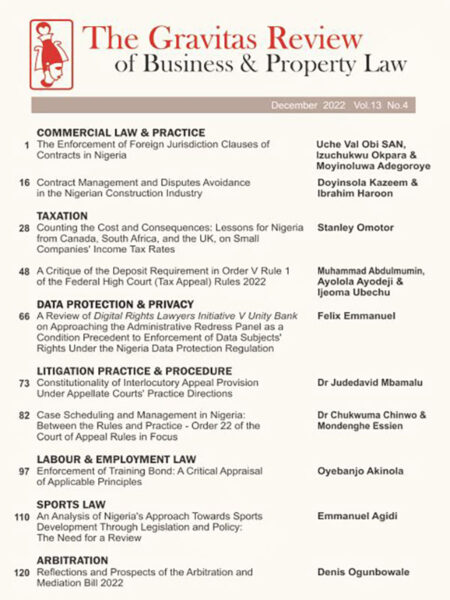
The Gravitas Review of Business & Property Law Vol.13 No.4 – Print
0₦5,000.00In this issue of The Gravitas Review of Business & Property Law Vol.13 No.4, there are well researched articles on:
- Commercial Law & Practice
- Taxation
- Data Protection & Privacy
- Litigation Practice & Procedure
- Labour & Employment Law
- Sports Law
- Arbitration
-
The Gravitas Review of Business & Property Law Vol.13 No.4 – E-Book
0₦5,000.00In this issue of The Gravitas Review of Business & Property Law Vol.13 No.4, there are well researched articles on:
- Commercial Law & Practice
- Taxation
- Data Protection & Privacy
- Litigation Practice & Procedure
- Labour & Employment Law
- Sports Law
- Arbitration
-
The Gravitas Review of Business & Property Law Vol.13 No.4
0₦5,000.00In this issue of The Gravitas Review of Business & Property Law Vol.13 No.4, there are well researched articles on:
- Commercial Law & Practice
- Taxation
- Data Protection & Privacy
- Litigation Practice & Procedure
- Labour & Employment Law
- Sports Law
- Arbitration
-
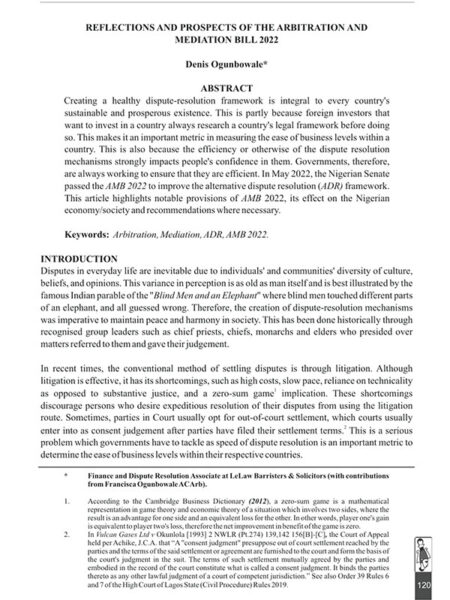
Reflections and Prospects of the Arbitration and Mediation Bill (AMB) 2022
0₦2,500.00Denis Ogunbowale of LeLaw Barristers & Solicitors reflects on the Arbitration and Mediation Bill, 2022, in his article, Reflections and Prospects of The Arbitration and Mediation Bill (AMB) 2022. He observes that creating a healthy dispute resolution framework is integral to every country’s sustainable and prosperous existence. He notes that the efficiency or otherwise of the dispute resolution mechanisms strongly impacts people’s confidence in them. In May 2022, the Nigerian Senate passed the AMB 2022 to improve the alternative dispute resolution (ADR) framework. Ogunbowale highlights notable provisions of AMB 2022, the likely effect on the ADR landscape, and the drawbacks of the Bill.
-
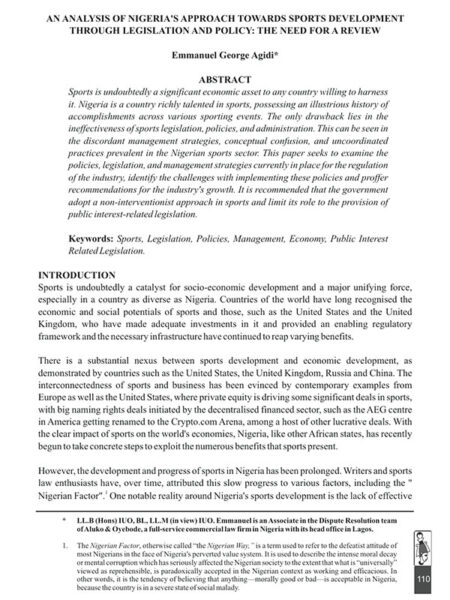
An Analysis of Nigeria’s Approach Towards Sports Development Through Legislation and Policy: The Need for a Review
0₦2,500.00Emmanuel Agidi, Associate at Aluko & Oyebode, in his article, An Analysis of Nigeria’s Approach Towards Sports Development Through Legislation and Policy: The Need for a Review, notes that Sports is, without doubt, a major economic asset to any country willing to harness it. Nigeria is richly talented in sports, possessing an illustrious history of accomplishments across various sporting events. The only drawback lies in the ineffectiveness of sports legislation, policies, and administration. This can be seen in the discordant management strategies, conceptual confusion, and uncoordinated practices prevalent in the Nigerian sports sector. Agidi examines the policies, legislation, and management strategies currently in place for regulating the sports industry in Nigeria identifying the challenges with implementing these policies, and proffers recommendations for the industry’s growth.
-
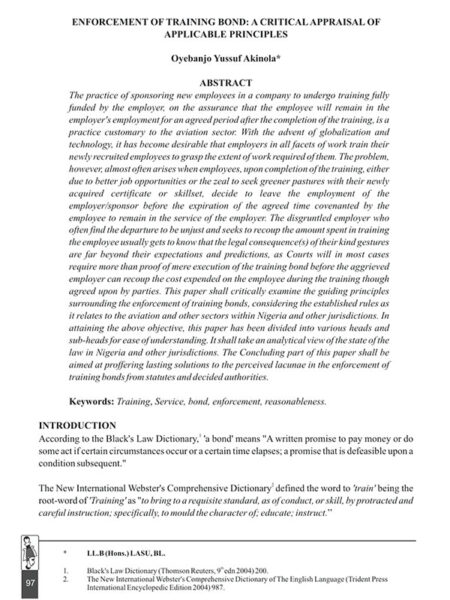
Enforcement of Training Bond: A Critical Appraisal of Applicable Principles
0₦2,500.00Oyebanjo Akinola, in his article, Enforcement of Training Bond: A Critical Appraisal of Applicable Principles, notes that the practice of sponsoring new employees in a company to undergo training fully funded by the employer on the assurance that the employee will remain in the employment of the employer for an agreed period after the completion of the training is a common practice in the workplace. The problem, however, almost often arises when employees, upon completion of the training, either due to better job opportunities or the zeal to seek greener pastures with their newly acquired certificate or skillset, decide to leave the employment of the employer/sponsor before the expiration of the agreed time. The disgruntled employer who often find the departure to be unjust and seeks to recoup the amount spent in training the employee usually gets to know that the legal consequences of their kind gestures are far beyond their expectations and predictions, as Courts will, in most cases require more than proof of mere execution of the training bond before the aggrieved employer can recoup the cost expended on the employee. Akinola critically examines the guiding principles surrounding the enforcement of training bonds, considering the established rules as it relates to aviation and other sectors within Nigeria and other jurisdictions.
-
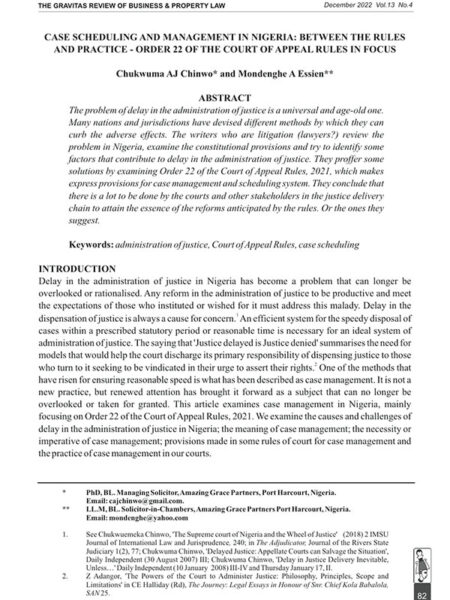
Case Scheduling and Management in Nigeria: Between the Rules and Practice – Order 22 of the Court of Appeal Rules in Focus
0₦2,500.00Dr Chukwuma Chinwo and Mondenghe Essien of the Amazing Grace Partners, Port Harcourt, Nigeria, in their article, Case Scheduling and Management in Nigeria: Between the Rules and Practice – Order 22 of the Court of Appeal Rules In Focus, note that the problem of delay in the administration of justice is a universal and age-old one. Many nations and jurisdictions have devised different methods by which they can curb the adverse effects. Chinwo and Essien review the problem in Nigeria, examine the constitutional provisions and identify some factors contributing to delay in the administration of justice. They proffer some solutions by examining Order 22 of the Court of Appeal Rules, 2021, which makes express provisions for case management and scheduling. They conclude that there is a lot to be done by the courts and other stakeholders in the justice delivery chain to attain the essence of the reforms anticipated by the rules.
-
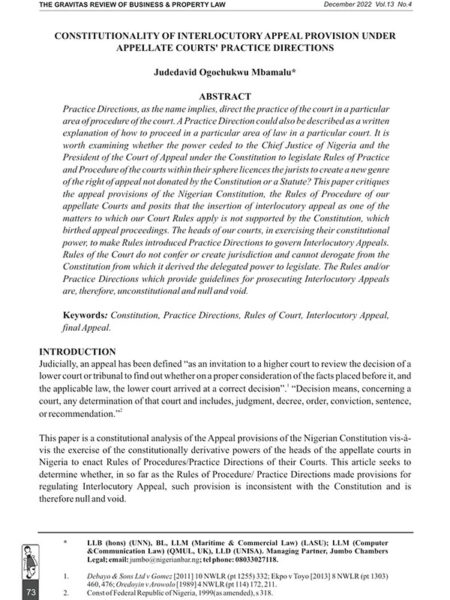
Constitutionality of Interlocutory Appeal Provision Under Appellate Courts’ Practice Directions
0₦2,500.00Dr Judedavid Mbamalu, Managing Partner, Jumbo Chambers, in his article, Constitutionality of Interlocutory Appeal Provision Under Appellate Courts’ Practice Directions, explains that Practice Directions direct the practice of the court in a particular area of procedure of the court. He examines whether the power ceded to the Chief Justice of Nigeria and the President of the Court of Appeal under the Constitution to legislate Rules of Practice and Procedure of the courts within their sphere, licenses the jurists to create a new genre of a right of appeal not donated by the Constitution or a Statute? He critiques the appeal provisions of the Nigerian Constitution and the Rules of Procedure of our appellate Courts. He posits that the insertion of interlocutory appeal, as one of the matters to which our Court Rules apply, is not supported by the Constitution, which birthed appeal proceedings.
-
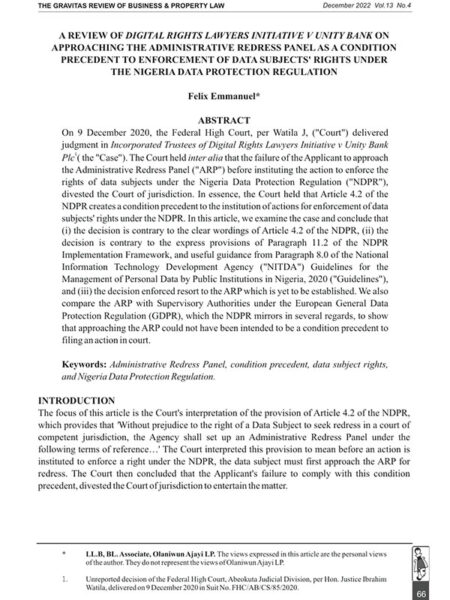
A Review of Digital Rights Lawyers Initiative V Unity Bank on Approaching the Administrative Redress Panel as a Condition Precedent to an Action Under the Nigeria Data Protection Regulation
0₦2,500.00Felix Emmanuel, Associate at Olaniwun Ajayi LP, in his article, A Review of Digital Rights Lawyers Initiative V Unity Bank on Approaching the Administrative Redress Panel as a Condition Precedent to an Action Under the Nigeria Data Protection Regulation, critically examines the decision of the Federal High Court in Incorporated Trustees of Digital Rights Lawyers Initiative v Unity Bank Plc (the “Case”) where the Court held that the failure of the Applicant to approach the Administrative Redress Panel before instituting the action to enforce the rights of data subjects under the Nigeria Data Protection Regulation (“NDPR”), divested the Court of jurisdiction. The Court held that Article 4.2 of the NDPR creates a condition precedent to the institution of actions to enforce data subjects’ rights under the NDPR. Emmanuel masterfully examines all aspects of the Case against the backdrop of relevant laws and regulations.
-
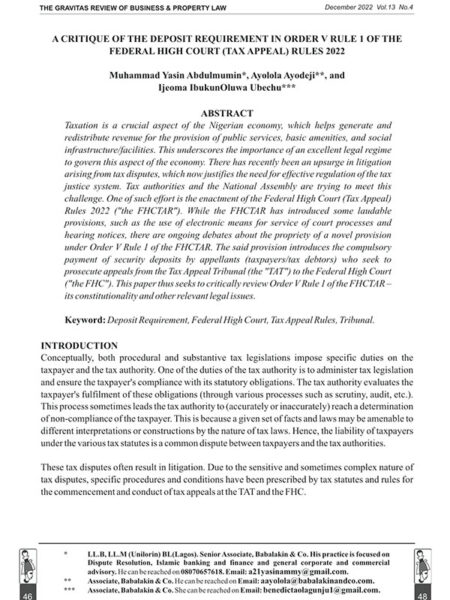
A Critique of the Deposit Requirement in Order V Rule 1 of the Federal High Court (Tax Appeal) Rules, 2022
0₦2,500.00Muhammad Abdulmumin, Ayolola Ayodeji and Ijeoma Ubechu, all of Babalakin & Co, in their article, A Critique of the Deposit Requirement in Order V Rule 1 of the Federal High Court (Tax Appeal) Rules, 2022, examine the provision of the Federal High Court (Tax Appeal) Rules 2022 (the FHCTAR) which introduces the compulsory payment of security deposits by appellants (taxpayers/tax debtors) who seek to prosecute appeals from the Tax Appeal Tribunal to the Federal High Court. Abdulmumin et al in their brilliant article, critically review Order V Rule 1 of the FHCTAR, its constitutionality, and other relevant legal issues.
-
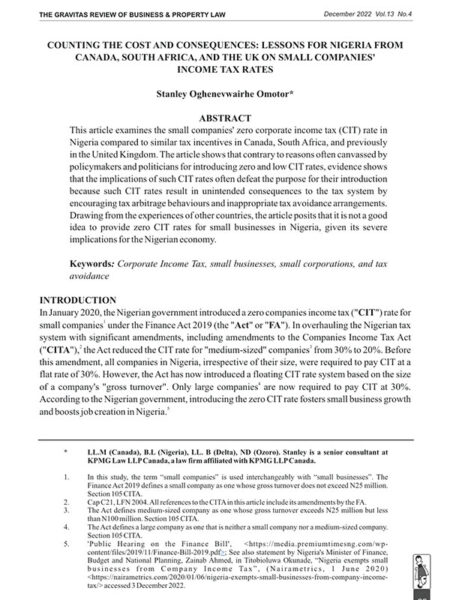
Counting the Cost and Consequences: Lessons for Nigeria from Canada, South Africa, and the UK, on Small Companies’ Income Tax Rates
0₦2,500.00Stanley Omotor, senior consultant at KPMG Law LLP Canada, a law firm affiliated with KPMG LLP Canada, in his article, Counting the Cost and Consequences: Lessons for Nigeria from Canada, South Africa, and the UK, on Small Companies’ Income Tax Rates, examines the small companies zero corporate income tax (CIT) rate in Nigeria, in comparison with similar tax incentives existing in Canada, South Africa, and previously in the United Kingdom. Omotor shows that contrary to reasons often canvassed by policymakers for introducing zero and low CIT rates, evidence shows that the implications of such CIT rates often defeat the purpose for their introduction because such CIT rates result in unintended consequences to the tax system by encouraging tax arbitrage behaviours and inappropriate tax avoidance arrangements. Drawing from the experiences of other countries, Omotor posits that it is not a good idea to provide zero CIT rates for small businesses in Nigeria, given its severe implications for the Nigerian economy.
The Gravitas Review of Business & Property Law