-
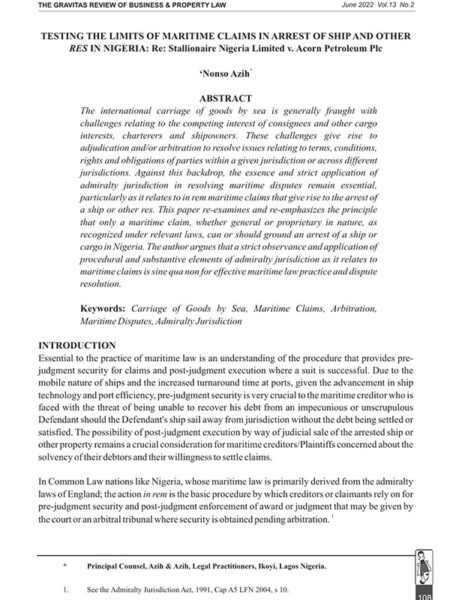
Testing the Limits of Maritime Claims in Arrest of Ship and Other Res in Nigeria: Re: Stallionaire Nigeria Limited v Acorn Petroleum Plc
0₦2,500.00Nonso Azih, Principal Counsel Azih & Azih, in his article, Testing the Limits of Maritime Claims in Arrest of Ship and Other Res in Nigeria: Re: Stallionaire Nigeria Limited v Acorn Petroleum Plc, notes that international carriage of goods by sea is generally fraught with challenges relating to the competing interest of consignees and other cargo interests, charterers and shipowners. These challenges give rise to adjudication or arbitration to resolve issues relating to parties’ terms, conditions, rights, and obligations. The essence and strict application of admiralty jurisdiction in resolving maritime disputes remain essential, particularly as it relates to in rem maritime claims that give rise to the arrest of a ship or other res. Nonso re-examines and re-emphasises the principle that only a maritime claim, whether general or proprietary in nature, as recognised under relevant laws, can or should ground an arrest of a ship or cargo in Nigeria. He argues that a strict observance and application of procedural and substantive elements of admiralty jurisdiction as it relates to maritime claims is sine qua non for effective maritime law practice and dispute resolution.
-
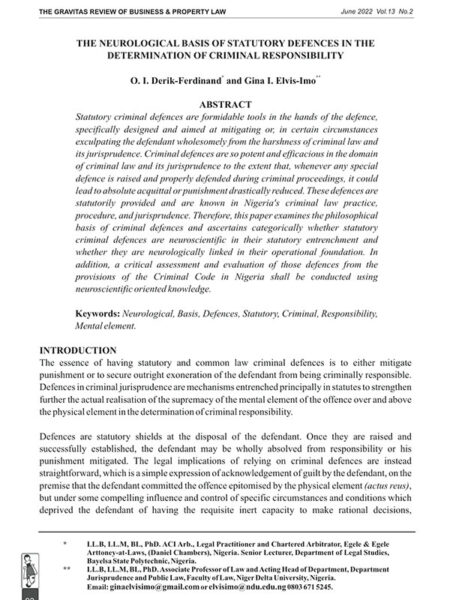
The Neurological Basis of Statutory Defences in the Determination of Criminal Responsibility
0₦2,500.00Dr O. I. Derik-Ferdinand, Senior Lecturer, Department of Legal Studies, Bayelsa State Polytechnic and Dr Gina Elvis-Imo, Acting Head of Department, Department of Jurisprudence and Public Law Niger Delta University, in their paper, The Neurological Basis of Statutory Defences in the Determination of Criminal Responsibility, explain that statutory criminal defences are formidable tools in the hands of the defence, specifically designed and aimed at mitigating or, in certain circumstances exculpating the defendant wholesomely from the harshness of criminal law. Derik-Ferdinand and Elvis-Imo examine the philosophical basis of criminal defences and ascertain whether statutory criminal defences are neuroscientific in their statutory entrenchment and whether they are neurologically linked in their operational foundation. In addition, they assess and evaluate the criminal defences from the provisions of the Criminal Code in Nigeria.
-
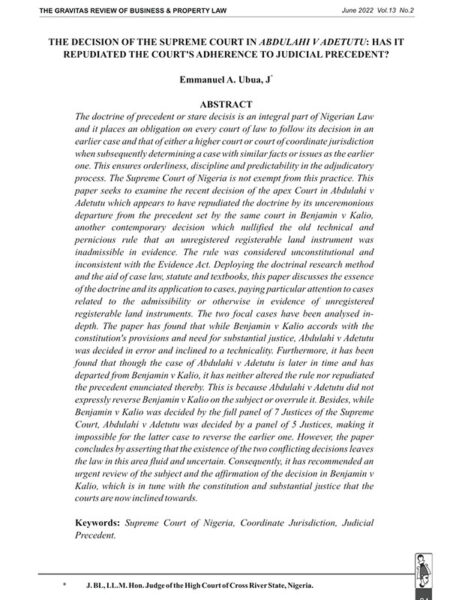
The Decision of The Supreme Court in Abdulahi v Adetutu: Has it Repudiated the Court’s Adherence to Judicial Precedent?
0₦2,500.00Honourable Justice Emmanuel Ubua of the High Court of Cross River State, in his article, The Decision of The Supreme Court in Abdulahi v Adetutu: Has it Repudiated the Court’s Adherence to Judicial Precedent? examines the decision of the Supreme Court in Abdulahi v Adetutu which appears to have repudiated the doctrine of stare decisis by its unceremonious departure from the precedent set by the same court in Benjamin v Kalio. The Supreme Court in Kalio nullified the old technical and pernicious rule that an unregistered registerable land instrument was inadmissible in evidence. The rule was considered unconstitutional and inconsistent with the Evidence Act. However, in the case of Abdulahi v Adetutu which was decided later, the Supreme Court seems to have somersaulted when it held that an unregistered instrument was inadmissible in evidence for breaching provisions of the Land Instruments Registration Law. Hon Justice Ubua comprehensively reviews the cases of Kalio and Adetutu and posits that while Kalio accords with constitutional provisions and the need for substantial justice, Adetutu was decided in error and inclined to technicality. Hon Justice Ubua recommends an urgent affirmation of the decision in Kalio, which is in tune with the constitution and substantial justice.
-
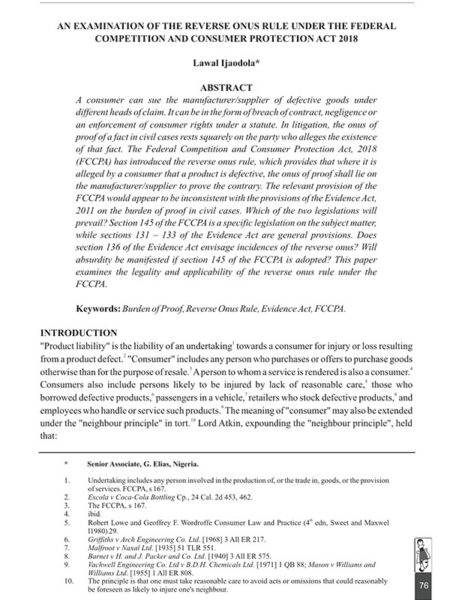
An Examination of The Reverse Onus Rule Under the Federal Competition and Consumer Protection Act 2018
0₦2,500.00Lawal Ijaodola, Senior Associate, G. Elias, in his article, An Examination of The Reverse Onus Rule Under the Federal Competition and Consumer Protection Act 2018, notes that a consumer can sue the manufacturer/supplier of defective goods under different causes of action. It can be in breach of contract, negligence, or an enforcement of consumer rights under a statute. In litigation, the onus of proof of a fact in civil cases rests squarely on the party who alleges the existence of that fact. The Federal Competition and Consumer Protection Act 2018 (FCCPA) has introduced the reverse onus rule, which provides that where it is alleged by a consumer that a product is defective, the onus of proof shall lie on the manufacturer/supplier to prove that the product is not defective. The relevant provision of the FCCPA would appear to be inconsistent with the provisions of the Evidence Act 2011 on the burden of proof in civil cases. Which of the two laws will prevail? Section 145 of the FCCPA is a specific legislation on the subject matter, while sections 131 – 133 of the Evidence Act are general provisions. Does section 136 of the Evidence Act envisage incidences of the reverse onus? Will absurdity be manifested if section 145 of the FCCPA is adopted? Lawal examines the contending issues and the legality and applicability of the reverse onus rule under the FCCPA.
-
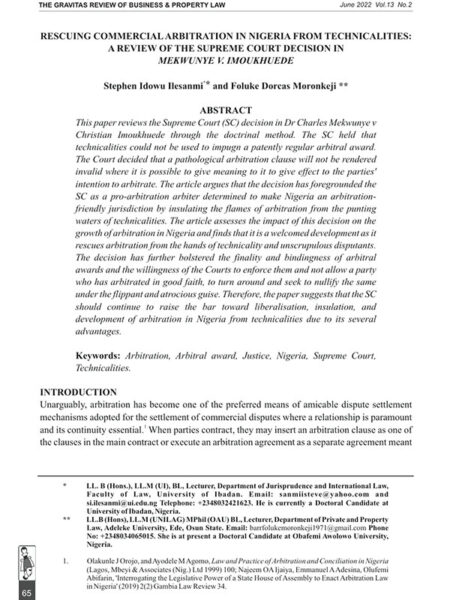
Rescuing Commercial Arbitration in Nigeria from Technicalities: A Review of the Supreme Court Decision in Mekwunye v Imoukhuede
0₦2,500.00Stephen Ilesanmi, Lecturer, University of Ibadan Nigeria and Foluke Moronkeji, Lecturer, Adeleke University Ede Nigeria, in their article, Rescuing Commercial Arbitration in Nigeria from Technicalities: A Review of the Supreme Court Decision in Mekwunye v Imoukhuede, review the Supreme Court’s (SC) decision in Mekwunye v Imoukhuede where the SC held that technicalities could not be used to impugn a patently regular arbitral award. The Court held that an arbitration clause would not be rendered invalid where it is possible to give meaning to it to give effect to the parties’ intention to arbitrate. Ilesanmi and Moronkeji argue that the SC decision has rescued arbitration from technicalities. They note that the decision has further bolstered the finality and bindingness of arbitral awards and the willingness of the Courts to enforce them and not allow a party who has arbitrated in good faith, to turn around and seek to nullify the same under flippant and atrocious guises.
-
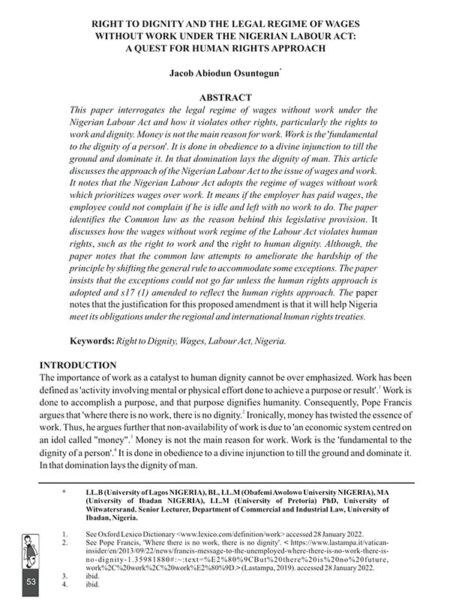
Right to Dignity and the Legal Regime of Wages Without Work Under the Nigerian Labour Act: A Quest for Human Rights Approach
0₦2,500.00Dr Jacob Osuntogun, Senior Lecturer, Department of Commercial and Industrial Law, University of Ibadan Nigeria, in his paper, Right to Dignity and the Legal Regime of Wages Without Work Under the Nigerian Labour Act: A Quest for Human Rights Approach, interrogates the legal regime of wages without work under the Nigerian Labour Act and how it violates other rights, particularly the rights to work and dignity. He argues that ‘money is not the main reason for work’ and work is fundamental to a person’s dignity. Dr Osuntogun notes that the Nigerian Labour Act prioritises the payment of wages. If the employer has paid wages, the employee could not complain if he is idle and left with no work to do. He argues that the wages without work regime of the Labour Act violates human rights and advocates an amendment of the Labour Act for Nigeria to meet its obligations under regional and international human rights treaties.
-
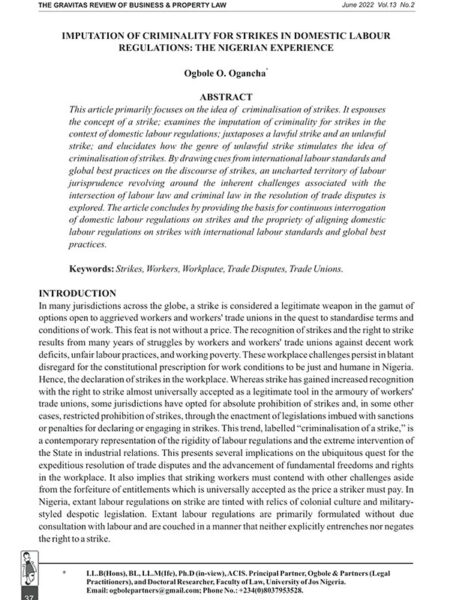
Imputation of Criminality for Strikes in Domestic Labour Regulations: The Nigerian Experience
0₦2,500.00Ogbole Ogancha of Ogbole & Partners, and Doctoral Researcher at the Faculty of Law, University of Jos Nigeria, in his article, Imputation of Criminality for Strikes in Domestic Labour Regulations: The Nigerian Experience, examines the imputation of criminality for strikes in the context of domestic labour regulations. He considers the concept of ‘lawful strikes’ and ‘unlawful strikes’ and argues that ‘unlawful strikes’ stimulate the idea of criminalisation of strikes. Ogancha explores Nigerian laws and regulations on the issue. Drawing cues from international labour standards and global best practices, he concludes that the criminalisation of strikes is not a sufficient or ideal deterrence. A progressive approach lies in the speedy identification of the causes of workers’ discontent.
-
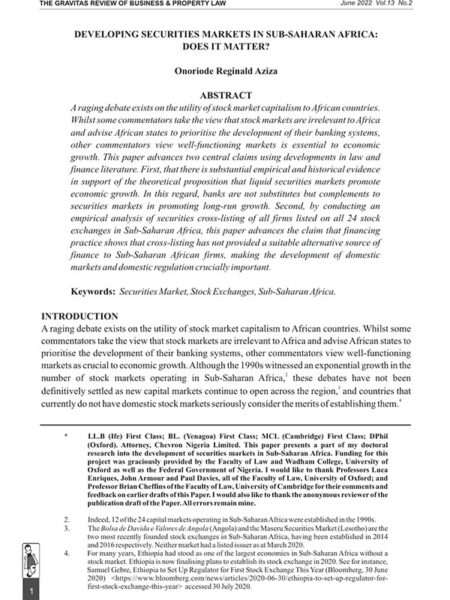
Developing Securities Markets in Sub-Saharan Africa: Does it Matter?
0₦2,500.00Dr Onoriode Aziza of Chevron Nigeria, in his landmark study, Developing Securities Markets in Sub-Saharan Africa: Does it Matter? notes the raging debate on the utility of stock market capitalism to African countries. Whilst some commentators take the view that stock markets are irrelevant to Africa and advise African states to prioritise the development of their banking systems, other commentators view well-functioning markets as essential to economic growth. Dr Aziza advances two central claims using developments in law and finance. First, there is substantial empirical and historical evidence supporting the theoretical proposition that liquid securities markets promote economic growth. In this regard, banks are not substitutes but complement securities markets in promoting long-run growth. Second, by conducting an empirical analysis of securities cross-listing of all firms listed on all 24 stock exchanges in Sub-Saharan Africa, Dr Aziza advances the claim that cross-listing has not provided a suitable alternative source of finance to Sub-Saharan African firms, making the development of domestic markets and regulation crucially important.
-
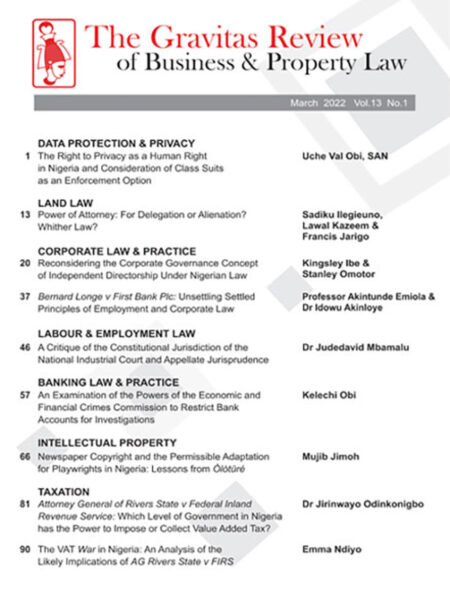
The Gravitas Review of Business & Property Law Vol.13 No.1 – Print
0₦5,000.00In this issue of The Gravitas Review of Business & Property Law Vol.13 No.1, there are well researched articles on:
- Data Protection & Privacy
- Land Law
- Corporate Law & Practice
- Banking Law & Practice
- Labour & Employment Law
- Intellectual Property
- Taxation
-
The Gravitas Review of Business & Property Law Vol.13 No.1 – E-Book
0₦5,000.00In this issue of The Gravitas Review of Business & Property Law Vol.13 No.1, there are well researched articles on:
- Data Protection & Privacy
- Land Law
- Corporate Law & Practice
- Banking Law & Practice
- Labour & Employment Law
- Intellectual Property
- Taxation
-
The Gravitas Review of Business & Property Law Vol.13 No.1
0₦5,000.00In this issue of The Gravitas Review of Business & Property Law Vol.13 No.1, there are well researched articles on:
- Data Protection & Privacy
- Land Law
- Corporate Law & Practice
- Banking Law & Practice
- Labour & Employment Law
- Intellectual Property
- Taxation
-
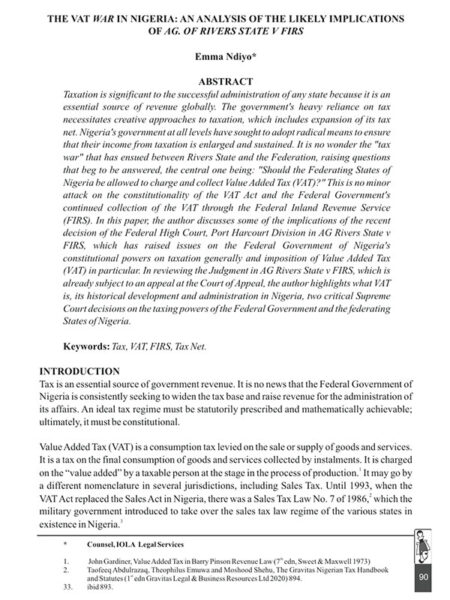
The VAT War in Nigeria: An Analysis of the Likely Implications of AG Rivers State v FIRS
0₦2,500.00Emma Ndiyo, Counsel at IOLA Legal Services, weighs in on the VAT debate in her article, The VAT War in Nigeria: An Analysis of the Likely Implications of AG Rivers State v FIRS. She discusses some of the implications of the recent decision of the Federal High Court in AG Rivers State v FIRS which has raised issues on the Federal Government of Nigeria’s constitutional powers on taxation generally and imposition of Value Added Tax (VAT) in particular. In reviewing AG Rivers State v FIRS, Emma highlights the historical development and administration of VAT in Nigeria. She reviews the Supreme Court decisions in AG Ogun State v Aberuagba and AG Lagos State v Eko Hotels on the taxing powers of the Federal Government and the federating states. She concludes with her thoughts on steps for improved tax administration in the country.
The Gravitas Review of Business & Property Law