-
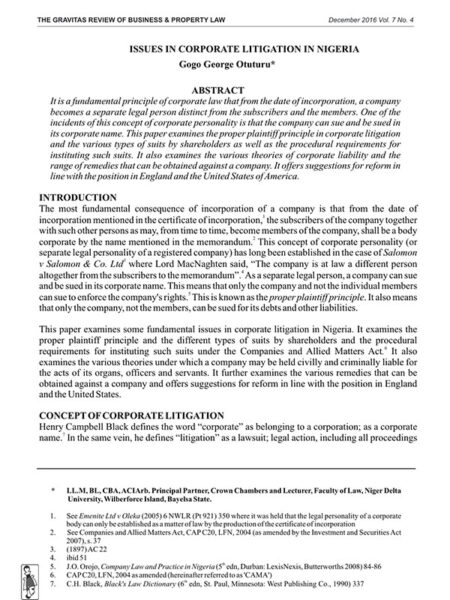
Issues in Corporate Litigation in Nigeria
0₦2,500.00Gogo Otuturu of the Faculty of Law, Niger Delta University, Wilberforce Island, Bayelsa State in his article “Issues in Corporate Litigation in Nigeria” examines a myriad of issues in corporate litigation including theories of corporate liability, the proper plaintiff principle, personal, representative and derivative actions by shareholders, pre-action notice and limitation period.
-
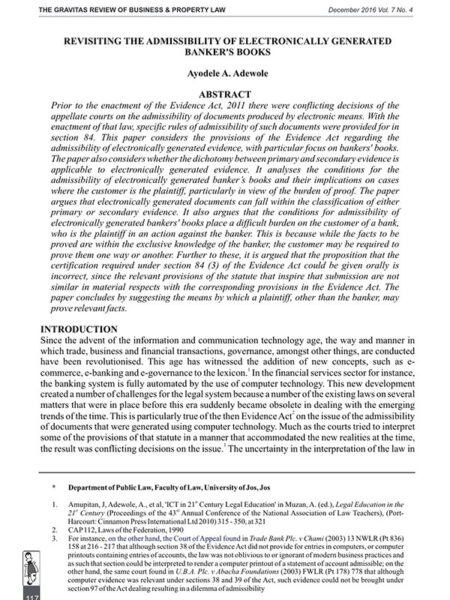
Revisiting the Admissibility of Electronically Generated Banker’s Books
0₦2,500.00Ayodele Adewole of the Department of Public Law, University of Jos in his rivetting article “Revisiting the Admissibility of Electronically Generated Bankers’ Books” analyses the provision of the Evidence Act, 2011 as it relates to the admissibility of electronically generated documents, especially bankers’ books. He considers whether the dichotomy between primary and secondary evidence is applicable to electronically generated evidence. He argues that the requirement for certification under section 84 places a difficult burden on the customer of a bank, who is the plaintiff in an action against the banker and has to prove a fact within the exclusive knowledge to the banker, who generates, stores and has custody of the record. In such a case, the interests of the party seeking to prove, and that of the party against who the document is sought to be proved is not coterminous, thereby resulting in frustration for the party seeking to prove the fact.
-
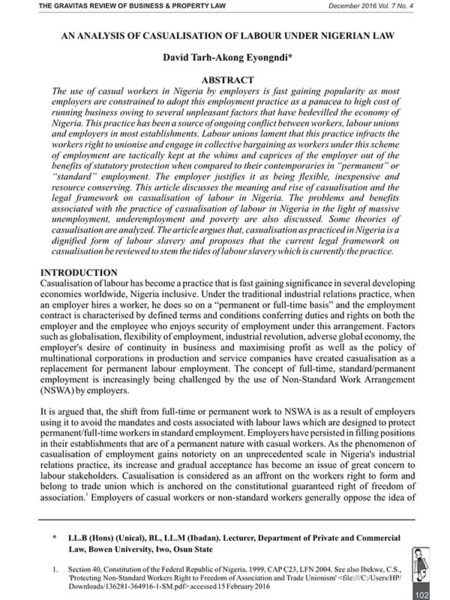
An Analysis of Casualisation of Labour under Nigerian Law
0₦2,500.00David Eyongndi of the Faculty of Law, Bowen University, Iwo, Osun State in his article, “An Analysis of Casualisation of Labour Under Nigerian Law” examines the use of Non-Standard Work Arrangement (NSWA) otherwise called ‘Casual Labour’ in Nigeria. He considers the rise, causes, effects and legal framework on casualisation. He argues that NSWA may not be as bad as it first seems, as it serves as a springboard for some workers to acquire necessary skills and experience to improve their permanent employability prospects. He recommends a regulation of the practice for the benefit of all stakeholders.
-
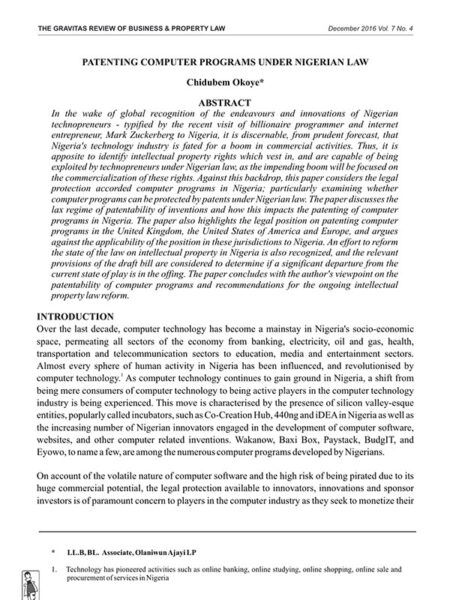
Patenting Computer Programs under Nigerian Law
0₦2,500.00In the wake of the increasing number of Nigerian innovators engaged in the development of computer software, websites and programs like Wakanow, Baxi Box, Paystack, BudgIT, and Eyowo, Chidubem Okoye, Associate at Olaniwun Ajayi LP in his article “Patenting Computer Programs Under Nigerian Law” considers the patentability of computer programs in Nigeria and the state of the law in US and Europe.
-
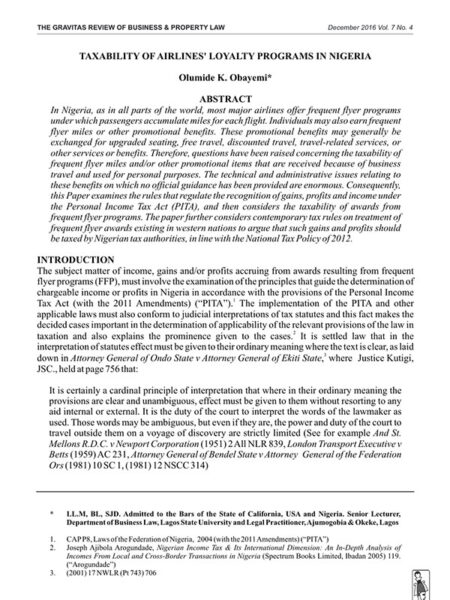
Taxability of Airlines’ Loyalty Programs in Nigeria
0₦2,500.00Dr. Olumide Obayemi, Legal Practitioner, Ajumogobia & Okeke and Senior Lecturer, Department of Business Law, Lagos State University Ojo in his article “Taxability of Airlines’ Loyalty Programs in Nigeria” examines the taxability of frequent flyer miles awards and other promotional benefits by airlines. Drawing comparison from US and Canada, he posits that airlines’ loyalty and promotional programs are “gain, profits and income” under the Personal Income Tax Act (PITA) and the beneficiaries of such programs are subject to tax on them.
-
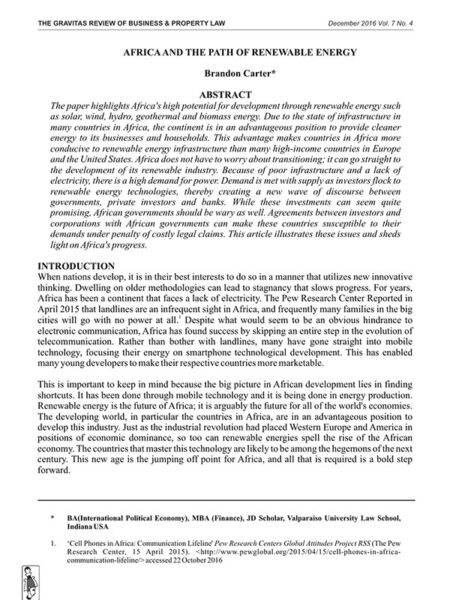
Africa and the Path of Renewable Energy
0₦2,500.00Brandon Carter, international political economist and JD Scholar, Valparaiso University Law School, Indiana USA in his article “Africa and the Path of Renewable Energy” highlights Africa’s potential for development through renewable energy such as solar, wind, hydro, geothermal and biomass. Just as countries in Africa skipped the transition to landlines in the telecommunications industry, he posits that Africa’s poor energy infrastructure deficit is an opportunity to leapfrog fossil fuel energy to clean renewable energy. While prospecting for foreign investments to fund renewable energy projects, he cautions African countries against Bilateral Investment Treaties (BITs) with Europe and the US especially those under the International Centre for the Settlement of Investment Disputes (ICSID) and advocated South-South BITs which are less skewed against capital importing countries.
-
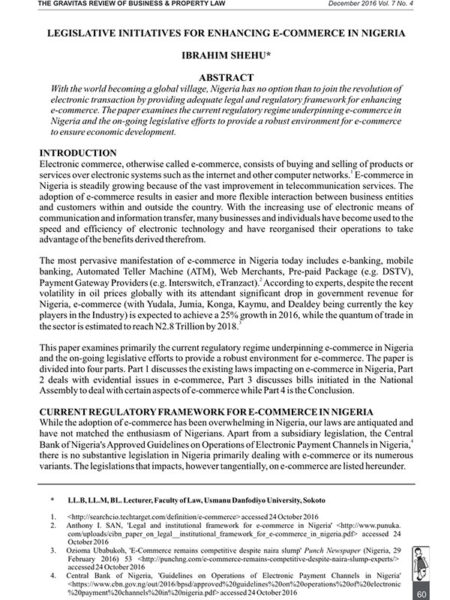
Legislative Initiatives for Enhancing E-Commerce in Nigeria
0₦2,500.00Ibrahim Shehu of the Faculty of Law, Usmanu Danfodiyo University, Sokoto in his article “Legislative Initiatives for Enhancing E-Commerce in Nigeria” considers some laws that impact on e-commerce in Nigeria. He argues that though there is no substantive legislation in Nigeria primarily dealing with e-commerce or its numerous variants, the Evidence Act 2011 has proven monumental in the development of e-commerce essentially in the admissibility of computer generated documents and recognition of electronic signatures. He examines some bills considered by the Seventh National Assembly which may remind the present Assembly of what needed to be done.
-
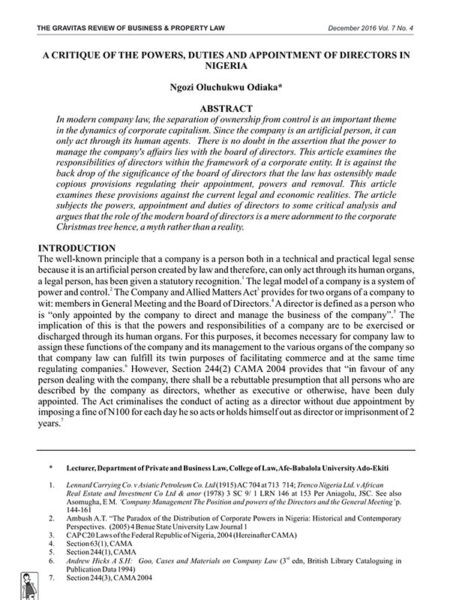
A Critique of the Powers, Duties and Appointment of Directors in Nigeria
0₦2,500.00Odiaka Ngozi of the Department of Private and Business Law, Afe-Babalola University, Ado-Ekiti in his article “A Critique of the Powers, Duties and Appointment of Directors in Nigeria” analyses the appointment, powers and duties of directors and distribution of corporate powers in a company. He explores the historical basis of the modern board structure and argues that the legal position that the board manages the company does not reflect practical realities as real corporate powers are wielded by ‘higher executive directors’ while the board of directors plays mere supervisory roles. He recommends a reform of the law to make the board more proactive.
-
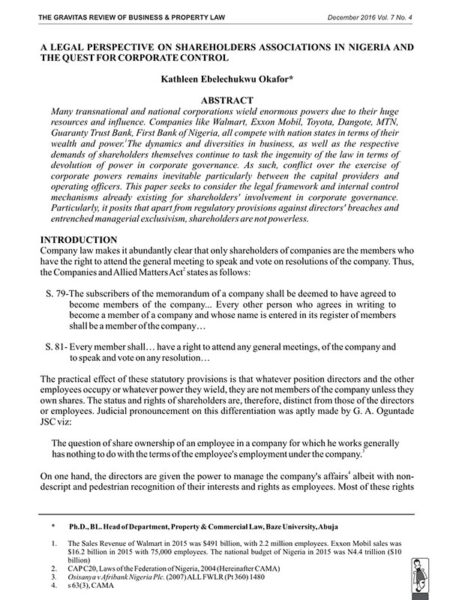
A Legal Perspective on Shareholders Associations in Nigeria and the Quest for Corporate Control
0₦2,500.00Dr Kathleen Okafor, Head, Department of Property & Commercial Law, Baze University, Abuja in “A Legal Perspective on Shareholders Associations in Nigeria and the Quest for Corporate Control” examines the origin and activities of shareholders’ association in context of the conflict over the exercise of corporate powers between the capital providers and operating officers. She explores the legal framework and control mechanisms existing for shareholders’ involvement in corporate governance and posits that apart from regulatory provisions against directors’ breaches and entrenched managerial exclusivism, shareholders are not powerless.
-
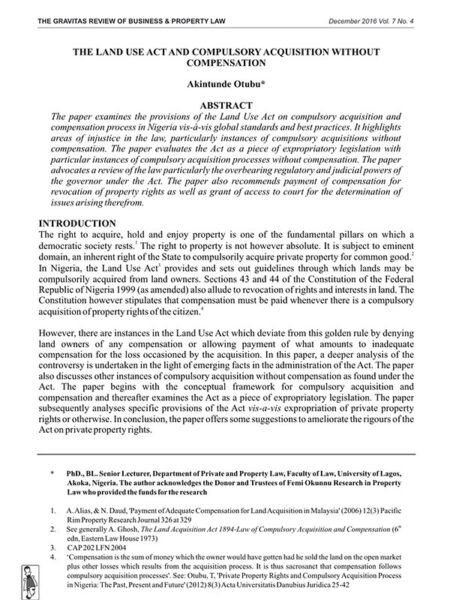
The Land Use Act and Compulsory Acquisition Without Compensation
0₦2,500.00Dr Akintunde Otubu, Senior Lecturer, Department of Private and Property Law, University of Lagos in his article “The Land Use Act and Compulsory Acquisition Without Compensation” examines the provision of the Land Use Act on compulsory acquisition and compensation. Weighing in on the controversy between the ‘nationalisation’ and ‘private property right’ schools, he contends that while the Act nationalises all land in favour of the State, it allows private ownership of the improvements on the land. He explores the half-hectare rule and four instances of revocations by which land is compulsorily acquired without compensation under the Act.
-
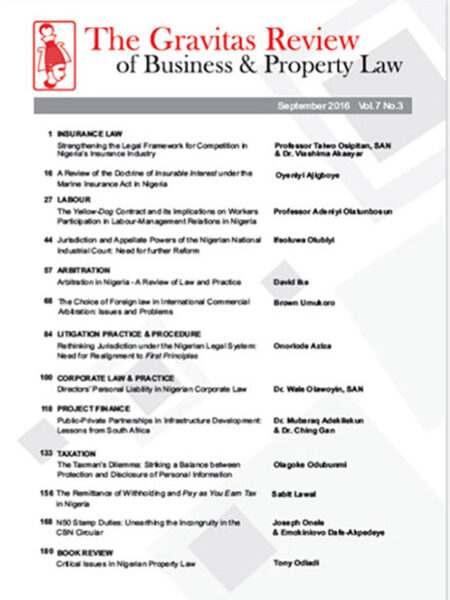
The Gravitas Review of Business & Property Law Vol.7 No.3 – Print
0₦5,000.00In this issue of The Gravitas Review of Business & Property Law Vol.7 No.3, there are well researched articles on:
- Mortgage Finance
- Insurance Law
- Labour
- Arbitration
- Litigation Practice & Procedure
- Corporate Law & Practice
- Project Finance
- Taxation
- Book Review
-
The Gravitas Review of Business & Property Law Vol.7 No.3 – E-Book
0₦5,000.00In this issue of The Gravitas Review of Business & Property Law Vol.7 No.3, there are well researched articles on:
- Mortgage Finance
- Insurance Law
- Labour
- Arbitration
- Litigation Practice & Procedure
- Corporate Law & Practice
- Project Finance
- Taxation
- Book Review
The Gravitas Review of Business & Property Law