-
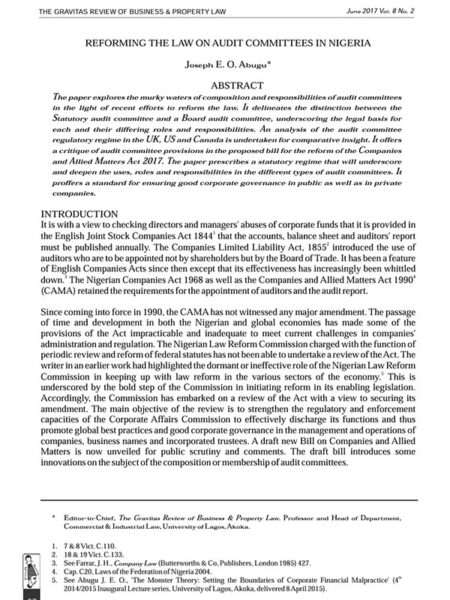
Reforming the Law on Audit Committees in Nigeria
0₦2,500.00Professor Joseph Abugu,Editor-in-Chief, The Gravitas Review of Business & Property Law and Head of Department, Commercial & Industrial Law, University of Lagos in his article “Reforming the Law on Audit Committees in Nigeria” against the background of the proposed bill for the reform of the Companies and Allied Matters Act 2017, explores the murky waters of composition and responsibilities of audit committees and delineates the distinction between the Statutory audit committee and a Board audit committee, underscoring the legal basis for each and their differing roles and responsibilities. He concludes with an analysis of the audit committee regulatory regime in the UK, US and Canada for comparative insight.
-
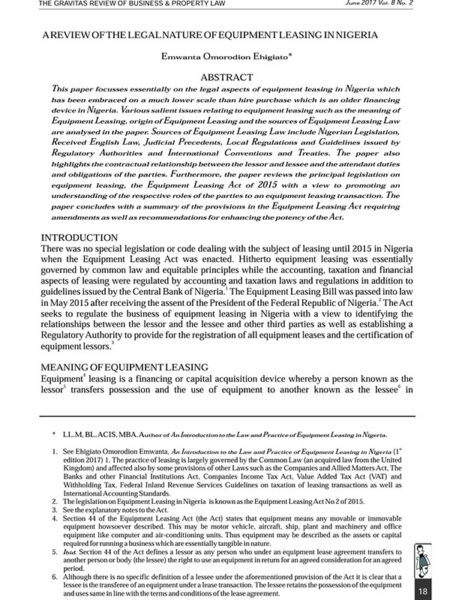
A Review of the Legal Nature of Equipment Leasing in Nigeria
0₦2,500.00Emwanta Ehigiato, author of An Introduction to the Law and Practice of Equipment Leasing in Nigeria in his article, “A Review of the Legal Nature of Equipment Leasing in Nigeria”, explores the legal aspects of equipment leasing which has been embraced on a much lower scale than hire purchase which is an older financing device in Nigeria. He analyses the legal framework for equipment leasing, the structure of an Equipment Lease Contract and obligations of parties. The paper undertakes a comprehensive review and commentary on the provision of the principal legislation on equipment leasing in Nigeria, Equipment Leasing Act of 2015.
-
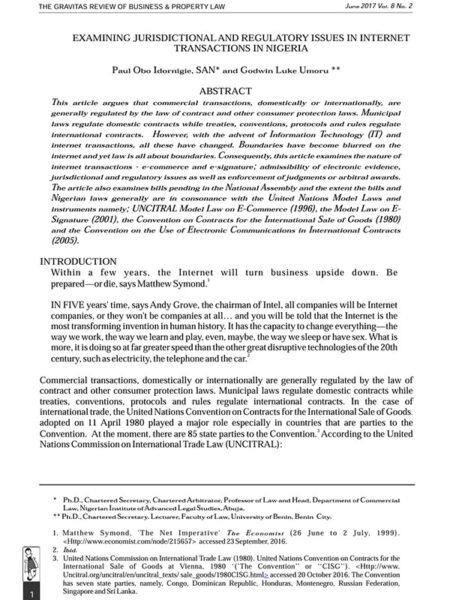
Examining Jurisdictional and Regulatory Issues in Internet Transactions in Nigeria
0₦2,500.00Professor Paul Idornigie SANof the Nigerian Institute of Advanced Legal Studies and Dr Godwin Umoru of the University of Benin in their article “Examining Jurisdictional and Regulatory Issues in Internet Transactions in Nigeria”, examine the extra-territorial nature of internet transactions and the challenges of applicable law, admissibility of electronic transmissions in evidence, enforceability of judgments, and how internet transactions are regulated. The article examines bills pending before the 8th National Assembly and the extent the bills and Nigerian laws generally conform to international conventions and protocols including the UNCITRAL Model Law on e-Commerce, the Model Law on E-Signature, the Convention on Contracts for the International Sale of Goods and the Convention on the Use of Electronic Communications in International Contracts.
-
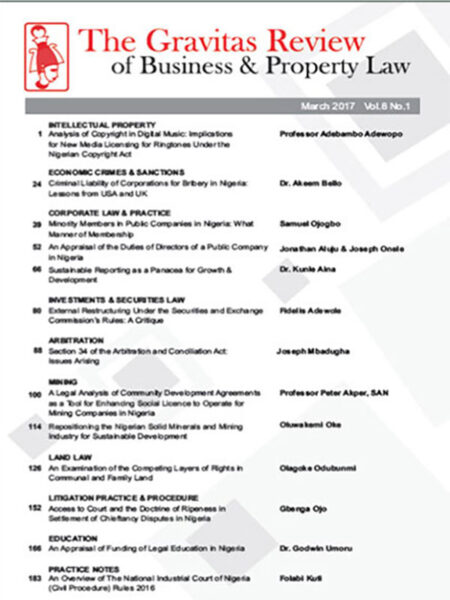
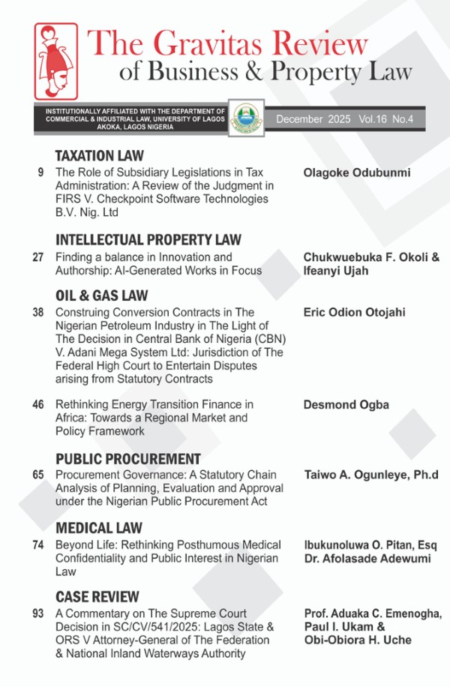
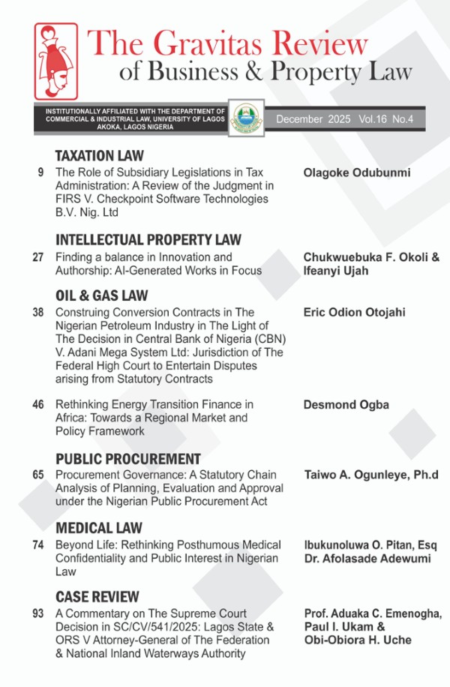
The Gravitas Review of Business & Property Law Vol.8 No.1 – Print
0₦5,000.00In this issue of The Gravitas Review of Business & Property Law Vol.8 No.1, there are well researched articles on:
- Intellectual Property
- Economic Crimes & Sanction
- Corporate Law & Practice
- Investments & Securities Law
- Arbitration
- Mining
- Land Law
- Litigation Practice & Procedure
- Education
- Practice Notes
-
The Gravitas Review of Business & Property Law Vol.8 No.1 – E-Book
0₦5,000.00In this issue of The Gravitas Review of Business & Property Law Vol.8 No.1, there are well researched articles on:
- Intellectual Property
- Economic Crimes & Sanction
- Corporate Law & Practice
- Investments & Securities Law
- Arbitration
- Mining
- Land Law
- Litigation Practice & Procedure
- Education
- Practice Notes
-
The Gravitas Review of Business & Property Law Vol.8 No.1
0₦5,000.00In this issue of The Gravitas Review of Business & Property Law Vol.8 No.1, there are well researched articles on:
- Intellectual Property
- Economic Crimes & Sanction
- Corporate Law & Practice
- Investments & Securities Law
- Arbitration
- Mining
- Land Law
- Litigation Practice & Procedure
- Education
- Practice Notes
-
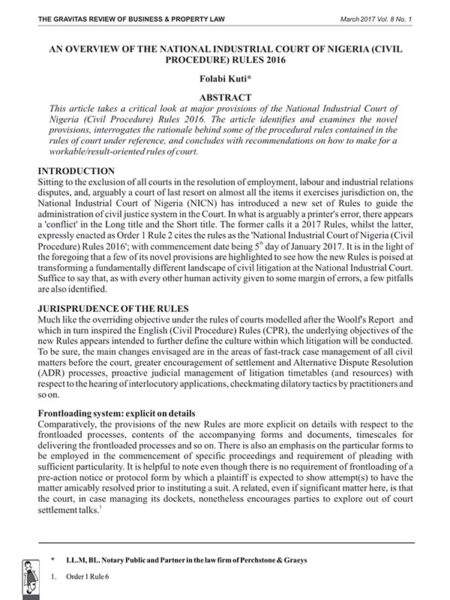
An Overview of the National Industrial Court (Civil Procedure) Rules 2016
0₦2,500.00Folabi Kuti, Partner, Perchstone & Graeys gives “An Overview of The National Industrial Court of Nigeria (Civil Procedure) Rules 2016” in his beautifully written article. He x-rays the salient and revolutionary provisions of the new Rules, the confusion between the short and long titles, and the applicability of ratified but undomesticated treaties by the National Industrial Court.
-
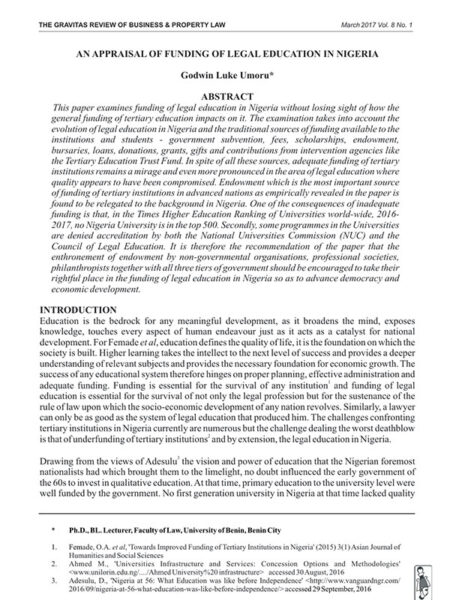
An Appraisal of Funding of Legal Education in Nigeria
0₦2,500.00Dr Godwin Umoru of the Faculty of Law, University of Benin in his article “An Appraisal of Funding of Legal Education in Nigeria” examines the historical trajectory and framework for funding legal education in Nigeria, ranking of Nigerian universities among their African peers, endowment and other options for sustainable funding and development of legal education.
-
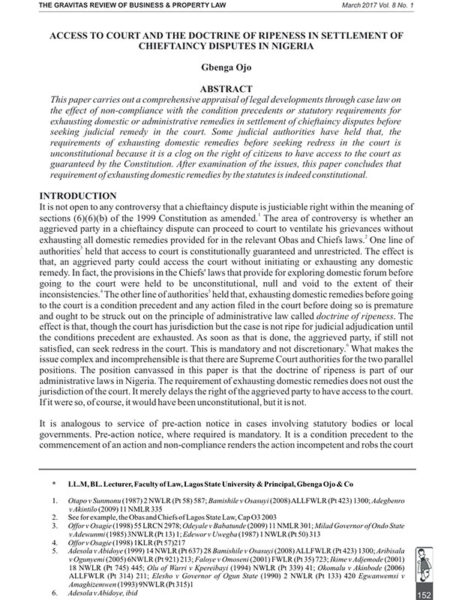
Access to Court and the Doctrine of Ripeness in Settlement of Chieftaincy Disputes in Nigeria
0₦2,500.00Gbenga Ojo, Lecturer, Lagos State University and Principal, Gbenga Ojo & Co in his article “Access to Court and the Doctrine of Ripeness in Settlement of Chieftaincy Disputes in Nigeria” undertakes a comprehensive appraisal, through case law, of the effect of non-compliance with the conditions precedent or statutory requirements for exhausting administrative remedies in settlement of chieftaincy disputes before seeking judicial remedy.
-
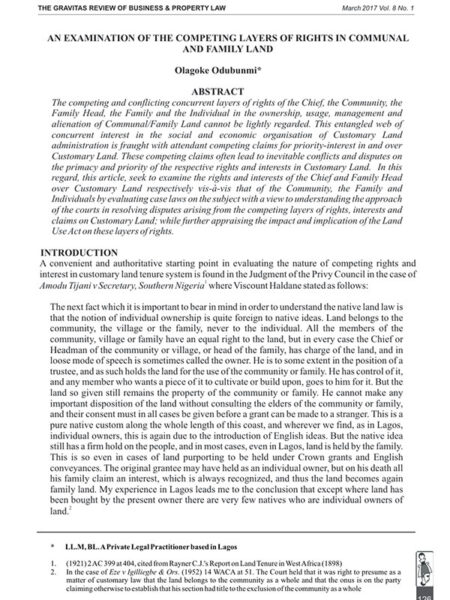
An Examination of the Competing Layers of Rights in Communal and Family Land
0₦2,500.00Olagoke Odubunmi, Lagos-based legal practitioner in his article, “An Examination of the Competing Layers of Rights in Communal and Family Land” exhaustively discusses the competing, conflicting and concurrent layers of rights of the Chief, the Community, the Family Head, the Family and the Individual in the ownership, usage, management and alienation of Communal/Family Land, and the impact and implication of the Land Use Act on the layers of rights.
-
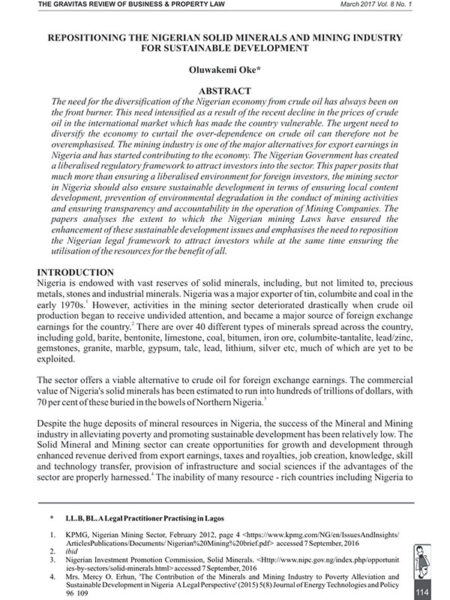
Repositioning the Nigerian Solid Minerals and Mining Industry for Sustainable Development
0₦2,500.00Oluwakemi Oke, Lagos-based legal practitioner in her article “Repositioning the Nigerian Solid Minerals and Mining Industry for Sustainable Development” explores the legal and regulatory framework of the Nigerian mining sector. She analyses local content development and participation, environmental protection and the role of the Nigerian Extractive Industries Transparency Initiative (“NEITI”) in ensuring transparency and accountability in the mining sector.
-
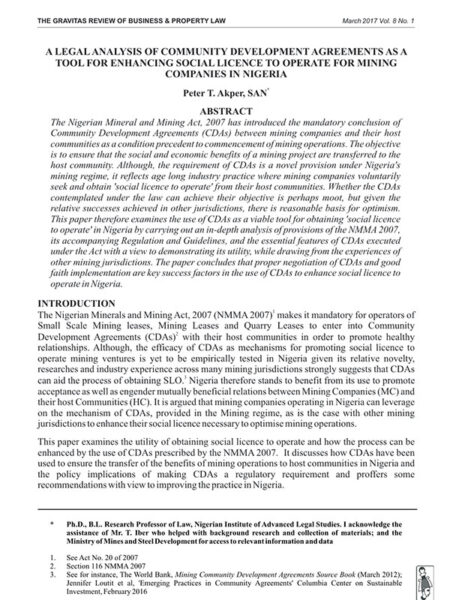
A Legal Analysis of Community Development Agreements as a Tool for Enhancing Social Licence to Operate for Mining Companies in Nigeria
0₦2,500.00Professor Peter Akper, SAN of the Nigerian Institute of Advanced Legal Studies in his article “A Legal Analysis of Community Development Agreements as a Tool for Enhancing Social Licence to Operate for Mining Companies in Nigeria” examines the provision of the Nigerian Mineral and Mining Act 2007 which introduced the mandatory conclusion of Community Development Agreements (CDAs) between mining companies and their host communities as a condition precedent to commencement of mining operations. He examines CDA as a ‘Social Licence to Operate’ , its essential features and enforceability. He concludes by x-raying three typical CDAs concluded by mining companies with Gimbi, Durumi and Piyyakasa communities.
The Gravitas Review of Business & Property Law